


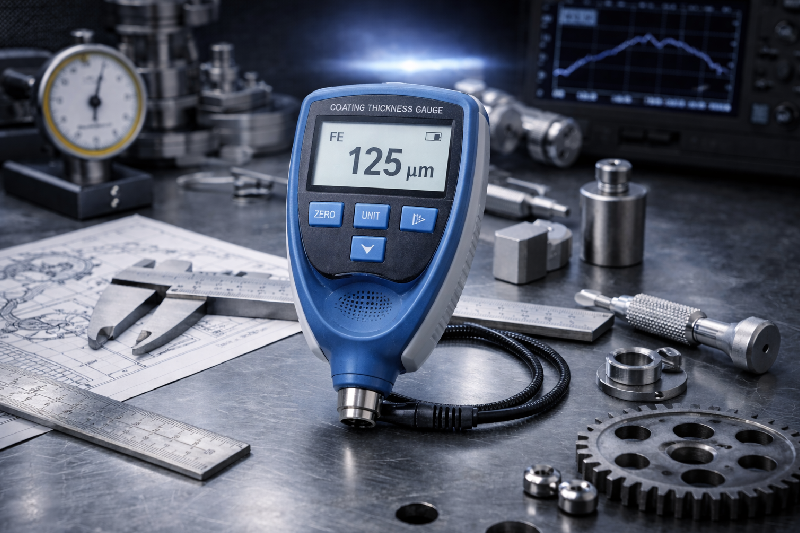
In 2026, Indian industries are rapidly modernizing, with quality control standards becoming more stringent and competitive. Whether you’re in automotive manufacturing, infrastructure, metal fabrication, or protective coatings services, ensuring the correct coating thickness is a non-negotiable part of quality assurance. This is where the right coating thickness gauge becomes indispensable. In this ultimate guide, we’ll walk you through everything you need to know before investing in a reliable coating thickness gauge or dft meter for your business.
What Is a Coating Thickness Gauge and Why It Matters?
A coating thickness gauge — also known as a thickness gauge paint tool or dft meter (Dry Film Thickness meter) — is a handheld instrument used to measure the thickness of coatings (such as paint, powder coat, galvanizing or anodizing) applied onto substrates like metals. These measurements are critical to ensure that protective layers meet design, performance, and compliance standards.
In Indian industries, where corrosion protection, surface finish, regulatory conformity, and product longevity are key, accurate coating measurements can reduce failures, improve product quality, and save significant rework costs.
Why Indian Businesses Should Prioritize Coating Thickness Measurement?
In sectors like automotive, construction, heavy machinery, and oil & gas, coatings protect against corrosion, wear and tear, and environmental damage. Incorrect coating thickness leads to –
- Reduced service life of parts and structures
- Non-compliance with industry standards (ISO, ASTM, SSPC, NACE)
- Increased maintenance costs down the line
A dft meter ensures consistent coating application — whether on steel bridges, pipelines, or automobile panels — and supports quality inspectors with reliable data.
Key Factors to Consider When Buying a Coating Thickness Gauge
Investing in the right coating thickness gauge isn’t just about the lowest price. It’s about matching technology to your specific application needs –
1. Substrate Compatibility
Choose a gauge that can measure coatings on –
- Ferrous metals (Fe) such as steel and iron
- Non-ferrous metals (NFe) such as aluminium and copper
- Or both (combined Fe/NFe capability)
Some gauges automatically detect the substrate type for you, making them ideal for mixed material environments.
2. Coating and Measurement Range
Different industrial coatings vary widely in thickness. For example –
- Automotive paint layers may be thin (a few microns)
- Industrial anti-corrosion coatings can reach several thousand microns
Ensure your thickness gauge paint tool or dft meter covers the range you need with sufficient resolution and repeatability. Higher measuring ranges are often essential for flame-retardant or specialized coatings.
3. Accuracy and Precision
Accuracy is vital in quality-critical applications. Look for gauges with –
- High resolution (µm or mils)
- Low measurement error (expressed as ±% + fixed value)
- Consistent repeatability
These attributes ensure that every measurement is trustworthy and comparable.
4. Probe Type and Ergonomics
Probes are where the gauge meets the surface. There are several probe types –
- Built-in probes, for general use
- External probes for confined spaces
- Specialised probes for curves or hard-to-reach areas
Good ergonomics and rugged physical design improve usability in harsh industrial settings.
5. Calibration and Standards Compliance
A reliable dft meter should support –
- Zero calibration
- Foil calibration
- Multi-point calibration
Proper calibration — as per industry standards — helps maintain accuracy over time and across different materials and environments.
6. Data Handling and Connectivity
Modern coating thickness gauges often feature –
- Memory storage
- USB or Bluetooth connectivity
- PC software for analysis and reporting
This is particularly valuable for documentation, audits, and traceability, especially in regulated industries or large-scale operations.
Types of Coating Thickness Gauges Commonly Used
Dry Film Thickness (DFT) Meters
These are the most widely used type of thickness measuring tools in India and globally. DFT meters are handheld, non-destructive, and ideal for most industrial surface-coating applications. They use magnetic induction or eddy current principles to measure coatings on metal surfaces.
Specialized Gauges for Advanced Applications
- Ultrasonic coating thickness gauges for non-metallic substrates
- High-range gauges for thick protective layers
- Advanced digital gauges with enhanced data logging
Applications Across Indian Industries
A coating thickness gauge is versatile and finds usage in multiple sectors –
- Automotive & Auto Components – Quality inspection of paint and coatings
- Manufacturing – Ensuring protective layers are applied uniformly
- Oil & Gas – Coating checks on pipelines and structural metal
- Infrastructure – Quality control for bridges, towers, and steel structures
- Fabrication & Welding – Verifying post-coating conditions
With these gauges, businesses can improve product reliability, demonstrate compliance, and enhance customer satisfaction.
Buying Tips for Indian Businesses
- Always prioritise quality and proven performance over the lowest price.
- Opt for gauges that meet recognised standards and offer robust after-sales support.
- Consider long-term serviceability and calibration support in India.
- Test-drive units (if possible) to assess ease of use before purchase.
The right coating thickness gauge, thickness gauge paint, or dft meter is more than a tool — it’s a strategic investment in quality, compliance, and operational excellence. With India’s industrial landscape evolving fast in 2026, precision measurement tools have never been more essential.
Arming your team with the correct gauge ensures consistent quality control, protects your assets, and helps deliver world-class products that stand the test of time.