


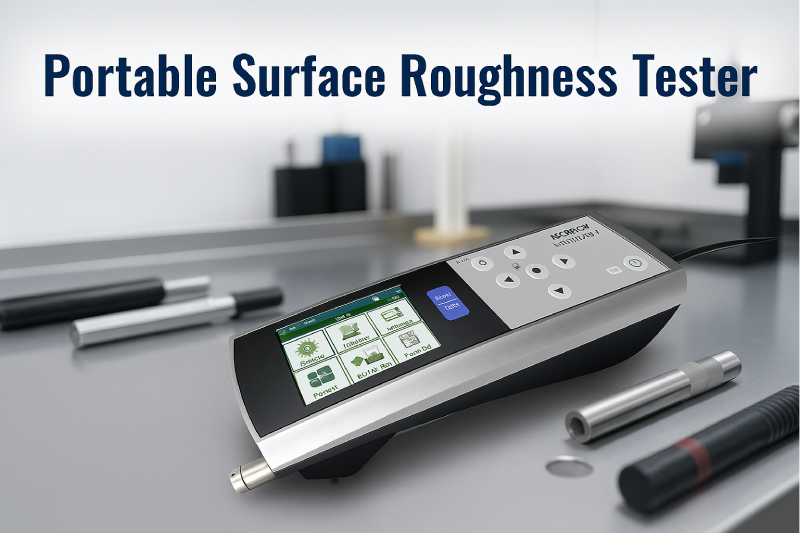
Understanding Surface Roughness Measurement
Surface roughness measurement plays a crucial role in quality control and precision engineering. It helps determine the texture and irregularities of a material’s surface, which directly influence its performance, appearance, and wear resistance. A surface roughness measurement process allows industries to ensure components meet design and functional requirements with high accuracy.
The Ra tester (Roughness Average tester) is widely used for this purpose. It helps in evaluating the micro-irregularities formed during manufacturing processes such as machining, grinding, or polishing.
Difference Between Surface Roughness, Waviness, and Form
While all three terms describe aspects of surface texture, they differ in scale and cause:
- Surface Roughness: Refers to fine irregularities created by the cutting tool or abrasive particles during manufacturing. It defines how smooth or rough a surface feels.
- Waviness: Represents larger surface deviations that occur due to vibration, deflection, or machine imbalance.
- Form: Describes the overall shape or contour of the surface, ignoring small-scale variations.
How Surface Roughness Measurement Works
Surface irregularities are often too small to be visible to the naked eye. A surface roughness measurement instrument or Ra tester is used to detect and quantify them.
A stylus tip of the tester moves across the surface at a constant speed. The vertical movements of the stylus are recorded as electrical signals, which are then converted into graphical and numerical data. These readings help analyze the surface texture, identify machining defects, and ensure product consistency.
High-precision surface roughness testers are designed to measure even the finest variations with accuracy, offering repeatable results ideal for industrial applications.
Common Surface Roughness Parameters
To evaluate surface quality, several parameters are used. These parameters describe the vertical and horizontal features of a surface profile.
- Ra (Roughness Average): The most widely used parameter, representing the average deviation from the mean line.
- Rv: The maximum depth of a profile valley within the sampling length.
- Rp: The maximum height of a profile peak within the sampling length.
- Rt: The total height between the highest peak and deepest valley.
- Rz: The average difference between five highest peaks and five lowest valleys in the profile.
Among these, Ra surface roughness measurement is the global standard and a key indicator for quality control.
Applications of Surface Roughness Measurement
Surface roughness measurement is vital across multiple industries including automotive, aerospace, precision manufacturing, and medical device production. Some key applications include:
- Friction and Wear Analysis: Determines how surfaces interact under movement or load.
- Lubrication Studies: Ensures surfaces retain oil or fluid within micro valleys for proper lubrication.
- Sealing Efficiency: Helps achieve optimal sealing between two contact surfaces without excessive wear.
- Coating and Painting: Ensures the surface texture allows proper adhesion of paints or coatings.
- Tool and Process Monitoring: Identifies tool wear, improper feeds, or speed errors during machining.
While smoother surfaces are often desired, an optimal surface finish depends on the function. For example, certain roughness levels are beneficial for oil retention in engine parts.
Importance of Using Ra Tester in Quality Control
The Ra tester is an essential tool in precision industries. It provides accurate, repeatable, and quick measurements of surface roughness, enabling manufacturers to maintain consistent quality. Regular use of a surface roughness measurement tester helps detect machining errors early, reduces production costs, and ensures that finished components meet performance expectations.
Surface roughness directly affects product performance, longevity, and customer satisfaction. Accurate surface roughness measurement using an advanced Ra tester ensures every part meets the highest industrial standards. Whether for evaluating wear, ensuring proper lubrication, or maintaining a high-quality finish, surface texture analysis is indispensable in modern manufacturing.