

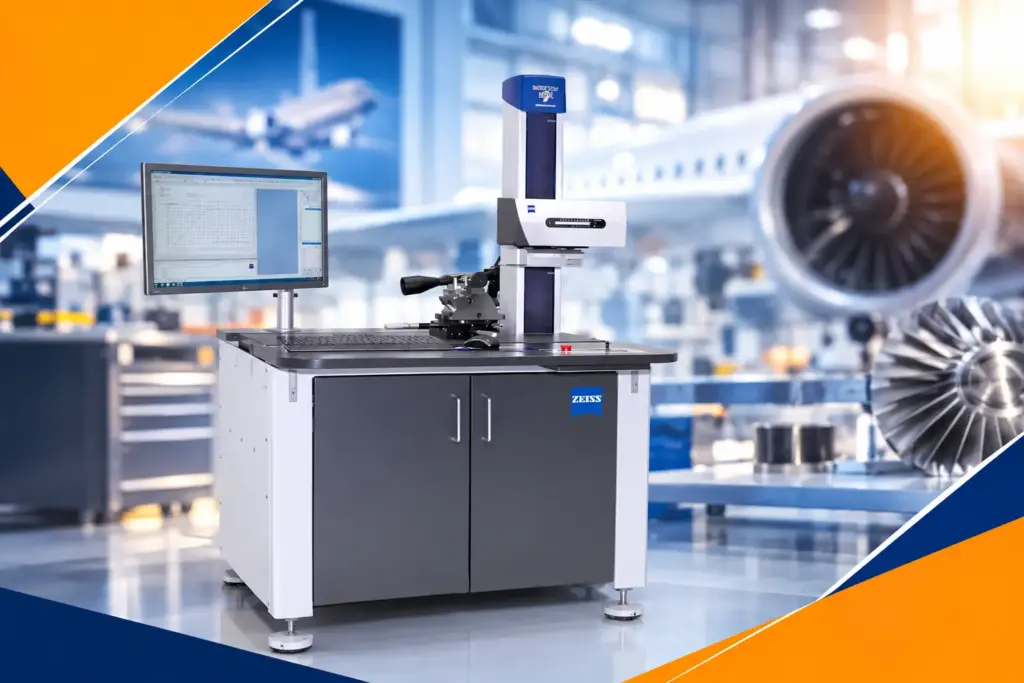
How Does a Surface Roughness Tester Improve Aerospace Component Quality?
In aerospace manufacturing, dimensional accuracy is only one part of component quality. A component can meet its dimensional drawing requirements and still have a surface finish that affects its functional performance. Microscopic peaks and valleys created during machining, grinding, polishing, turning or finishing can influence friction, wear, sealing, fatigue behaviour, coating performance and component life. For aerospace manufacturers, where components may operate under demanding mechanical, thermal and environmental conditions, controlling surface texture is therefore an important part of quality assurance. This is where a surface roughness tester becomes an important metrology tool. A surface roughness tester measures microscopic surface irregularities and converts them into quantitative parameters such as Ra, Rz, Rq and Rt. Instead of relying on visual inspection or operator judgement, manufacturers can use measured data to determine whether a surface meets the specified requirement. For aerospace manufacturers, the objective is not simply to obtain a “smooth-looking” surface. It is to establish whether the measured surface texture is appropriate for the component’s engineering specification and intended function. Table of Contents What Is Surface Roughness in Aerospace Manufacturing? Why Is Surface Finish Important for Aerospace Components? How Does a Surface Roughness Tester Work in Aerospace Inspection? What Problems Can Poor Surface Finish Cause in Aerospace Components? How Does a Surface Roughness Test Help Control Machining Quality? Which Aerospace Components Need Surface Roughness Testing? How Can a Surface Roughness Tester Improve Turbine Component Inspection? How Does Surface Roughness Testing Support Sealing and Contact Surfaces? Why Is Repeatability Important in Aerospace Surface Roughness Testing? How Can a Surface Roughness Tester Reduce Aerospace Manufacturing Rework? What Is the Role of a ZEISS Surface Roughness Tester in Aerospace QA? How Should Aerospace Manufacturers Select a Surface Roughness Tester? How Can QS Metrology Support Aerospace Surface Roughness Measurement? What Is a Practical Surface Roughness Test Workflow for Aerospace Components? Conclusion FAQs What Is Surface Roughness in Aerospace Manufacturing? Surface roughness refers to the fine-scale irregularities present on a manufactured surface. These microscopic peaks and valleys can result from processes such as: CNC milling CNC turning Grinding Honing Lapping Polishing Electrical discharge machining Surface finishing Other material-removal processes A component may appear smooth to the naked eye while still having measurable surface irregularities. A surface roughness tester quantifies these variations so that manufacturers can compare the measured result with the applicable engineering requirement. What Does a Surface Roughness Test Measure? A surface roughness test can provide different parameters describing the characteristics of a measured profile. Common parameters include: Ra – arithmetic average roughness Rz – a measure based on peak-to-valley characteristics Rq – root mean square roughness Rt – total profile height over the evaluated length The appropriate parameter depends on the engineering drawing, specification and application. QS Metrology’s current surface roughness page identifies Ra, Rz, Rq and Rt among the parameters supported by its surface roughness instruments. Why Is Surface Finish Important for Aerospace Components? Aerospace components can experience demanding operating environments. Depending on the application, components may be exposed to: Repeated mechanical loads High rotational speeds Temperature variations Friction Vibration Pressure Contact stresses Lubrication requirements Sealing requirements Surface texture can influence how two surfaces interact and how a component behaves during service. How Can Surface Roughness Affect Aerospace Component Performance? An inappropriate surface finish may influence: Friction Surface texture can affect the interaction between contacting or sliding surfaces. Wear Surface characteristics can influence wear behaviour during repeated movement or contact. Lubrication The microscopic texture of a surface can influence how lubricants interact with the surface. Sealing Controlled surface finish can be important for surfaces designed to form seals. Fatigue Surface irregularities can be relevant to the behaviour of components subjected to repeated loading. Coating or finishing Surface condition can affect subsequent finishing processes depending on the component and coating system. This is why surface finish should be treated as an engineering characteristic rather than simply a cosmetic feature. How Does a Surface Roughness Tester Work in Aerospace Inspection? A typical stylus-based surface roughness tester uses a precision stylus to trace a defined length of the component surface. As the stylus travels across microscopic peaks and valleys, its vertical movement is detected and converted into an electrical signal. The instrument’s electronics and software then process the signal and calculate the selected surface parameters. The basic process is: Surface → Stylus Movement → Signal → Digital Processing → Roughness Parameters → Inspection Result How Does a Surface Roughness Test Produce a Numerical Result? The tester evaluates the measured surface profile according to the selected measurement and evaluation settings. The result may include numerical values such as: Ra = measured value Rz = measured value Rq = measured value Rt = measured value The result can then be compared with the requirement defined for the component. This is significantly more useful for quality control than simply describing a component as “smooth” or “rough.” Why Is Controlled Measurement Important? Surface roughness measurements can be influenced by factors such as: Measurement direction Surface condition Component geometry Stylus condition Measurement settings Instrument calibration Operator technique Environmental conditions A standardized measurement procedure therefore helps improve repeatability. What Problems Can Poor Surface Finish Cause in Aerospace Components? Surface finish requirements vary according to the component and its intended function. However, uncontrolled surface roughness can create quality concerns. How Can Excessive Roughness Affect Contact Surfaces? Where two components interact mechanically, surface texture can influence friction, contact behaviour and wear. For precision aerospace components, uncontrolled surface characteristics can therefore become a manufacturing-quality concern. How Can Surface Finish Affect Sealing Surfaces? Some aerospace components include surfaces where controlled contact and sealing are important. If the surface texture does not meet the specified requirement, the component may require additional investigation or finishing. How Can Poor Surface Finish Increase Rework? If surface roughness is checked only at the final stage, a component that fails its surface specification may already have undergone: Machining Heat treatment Grinding Finishing Cleaning Inspection Assembly preparation Discovering the problem