


Every rejected part tells a costly story.
A missed tolerance. A tiny deviation. A batch that didn’t pass inspection. For precision engineering and machining businesses, rejection isn’t just waste—it’s lost revenue, delayed deliveries, and damaged client trust.
If you’re a QC head, production manager, or CNC engineer, you already know the pressure of maintaining tight tolerances while scaling production. Manual inspection methods often fall short, especially when accuracy demands are in microns.
That’s where a coordinate measuring machine (CMM) changes everything.
In this blog, we’ll break down how CMM technology helps reduce rejection rates, improve process consistency, and ultimately boost profitability in precision engineering environments.
Table of Contents
- Why Rejection Rates Are High in Machining Industries
- What is a Coordinate Measuring Machine (CMM)?
- How CMM Reduces Rejection Rates
- Key Benefits for Precision Engineering Businesses
- Choosing the Right CMM for Your Shop
- Conclusion + CTA
- FAQs
Why Rejection Rates Are High in Machining Industries?
Rejections don’t happen randomly. They are usually the result of small, compounding issues across production and inspection stages.
In many machining setups, traditional measurement tools like vernier calipers or micrometers depend heavily on operator skill. Even a slight variation in handling can lead to inconsistent results. Now multiply that across hundreds or thousands of parts—errors start stacking up.
Common causes of high rejection rates include:
- Inaccurate or inconsistent manual measurements
- Lack of real-time inspection during production
- Tool wear not detected early
- Complex geometries that are hard to measure manually
- Human error in recording or interpreting data
The result? Increased scrap, rework costs, and production delays.
What is a Coordinate Measuring Machine (CMM)?
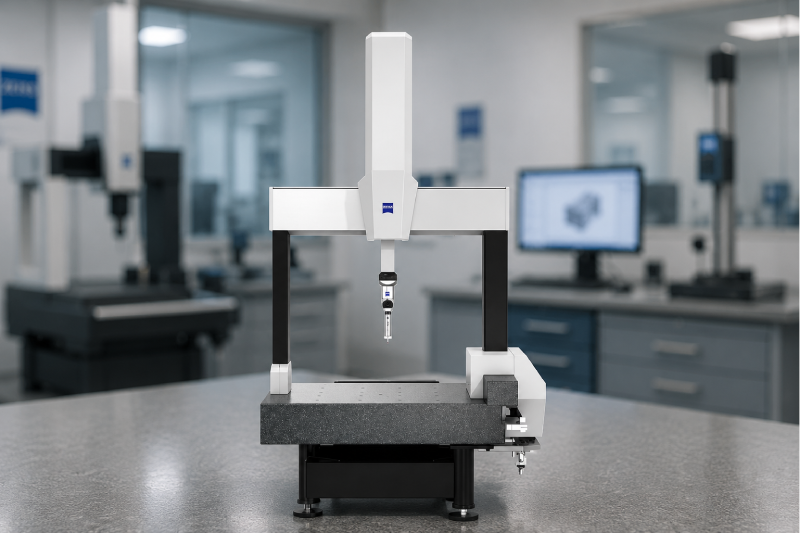
A coordinate measuring machine is an advanced inspection system that measures the physical geometry of parts with extreme precision. It uses a probe to collect data points from the surface of a component and compares them with CAD models or predefined specifications.
Unlike manual tools, a CMM delivers consistent, repeatable, and highly accurate measurements—regardless of operator variability.
There are different types of CMMs available today:
- Bridge CMM (for high-precision lab inspection)
- Portable CMM machine (ideal for shop-floor flexibility)
- Gantry and horizontal arm CMMs (for large components)
Leading solutions like the zeiss cmm machine are widely used for their reliability and advanced software integration.
How CMM Reduces Rejection Rates in Precision Engineering?
1. Eliminates Human Error in Measurement
One of the biggest advantages of using a coordinate measuring machine is the elimination of manual dependency. In traditional setups, measurement accuracy often varies between operators, shifts, or even time of day.
CMMs standardize the entire inspection process. Once programmed, they follow the same measurement path every time with micron-level precision. This consistency ensures that parts are evaluated accurately, reducing false rejections and unnoticed defects.
2. Detects Deviations Early in Production
Imagine catching a dimensional error after producing 500 parts. That’s a nightmare scenario.
With a portable CMM machine, you can bring inspection directly to the shop floor and measure parts during production. This enables real-time quality checks and helps identify deviations early.
Early detection means:
- Immediate corrective action
- Reduced batch rejection
- Lower scrap rates
Instead of reacting to problems, you start preventing them.
3. Handles Complex Geometries with Ease
Modern machined components often involve intricate designs, tight tolerances, and 3D profiles that are impossible to measure accurately with conventional tools.
CMMs excel in such scenarios.
They can capture thousands of data points across complex surfaces and generate precise measurement reports. This ensures that even the most complicated parts meet design specifications, significantly reducing rejection due to measurement limitations.
4. Improves Process Control and Consistency
When you use a coordinate measuring machine, you’re not just inspecting parts—you’re collecting valuable data.
This data helps in:
- Identifying process variations
- Monitoring tool wear trends
- Optimizing machining parameters
Over time, this leads to a more stable and controlled production process. And when your process is consistent, your rejection rates naturally drop.
5. Provides Accurate Documentation for Quality Compliance
For industries like automotive, aerospace, and medical manufacturing, documentation is critical.
CMMs generate detailed inspection reports that can be easily stored, shared, and audited. These reports provide proof of quality compliance and reduce the risk of rejection during client inspections.
This is especially valuable when working with high-value clients who demand strict quality assurance standards.
Key Benefits for Precision Engineering Businesses
Using a CMM is not just about reducing rejections—it’s about transforming your entire quality control process.
Here’s what you gain:
- Reduced scrap and rework costs
- Improved customer satisfaction and trust
- Faster inspection cycles
- Higher production efficiency
- Better decision-making with data-driven insights
Many businesses that adopt CMM technology report a significant drop in rejection rates within the first few months.
Choosing the Right CMM for Your Shop
Not all CMMs are the same, and choosing the right one depends on your production needs.
Here are a few factors to consider:
✔Type of Components
If you deal with small, high-precision parts, a bridge CMM is ideal. For larger or on-site inspections, a portable CMM machine offers flexibility.
✔ Accuracy Requirements
Different industries require different levels of precision. Make sure the machine meets your tolerance needs.
✔ Software Capabilities
Advanced software integration (like in a zeiss cmm machine) allows better data analysis, reporting, and automation.
✔ Budget and ROI
While CMMs are an investment, the reduction in rejection rates and rework costs often delivers quick ROI.
✔ Supplier Reliability
Working with trusted cmm manufacturers in india ensures better support, training, and after-sales service.
Conclusion: Reduce Rejections, Increase Profits
Rejection rates are not just a quality issue—they’re a business problem.
If you’re still relying on manual inspection methods, you’re leaving too much room for error. A coordinate measuring machine gives you the precision, consistency, and control needed to produce defect-free parts at scale.
In today’s competitive manufacturing environment, that’s not a luxury—it’s a necessity.
FAQs
How does a coordinate measuring machine reduce rejection rates?
A CMM ensures highly accurate and consistent measurements, eliminating human error and detecting defects early in production, which reduces rejections.
Is a portable CMM machine suitable for small workshops?
Yes, a portable CMM machine is ideal for small to mid-sized workshops as it offers flexibility and allows on-site inspection.
What industries benefit most from CMM technology?
Industries like automotive, aerospace, medical devices, and precision engineering benefit the most due to their strict tolerance requirements.
Are zeiss CMM machines worth the investment?
Yes, zeiss cmm machine solutions are known for their accuracy, reliability, and advanced software, making them a strong choice for high-precision applications.
How do I choose the right CMM manufacturer in India?
Look for experience, product range, service support, and client reviews when selecting from cmm manufacturers in india.