


A single weld failure in a railway track or metro structure isn’t just a defect—it’s a potential safety hazard, project delay, and financial loss rolled into one.
If you’re a QA head, project manager, or welding engineer, you’ve likely faced this:
Welds that pass initial checks but fail later… audits getting stricter… and traditional weld inspection methods catching problems too late.
That’s where welding penetration inspection systems step in.
Instead of reacting to defects, these systems help you detect issues at the root—literally inside the weld. In this blog, you’ll learn how weld penetration inspection is transforming safety, compliance, and cost-efficiency in railway and metro infrastructure projects—and why forward-thinking teams are adopting it now.
Table of Contents
- What is Welding Penetration and Why It Matters
- Challenges in Railway & Metro Weld Inspection
- How Welding Penetration Inspection Systems Work
- Benefits for Safety, Compliance & Cost
- Where It Fits in Your Inspection Workflow
- How to Choose the Right System
- FAQs
What is Welding Penetration and Why It Matters?
In simple terms, welding penetration refers to how deeply the weld metal fuses into the base material.
In railway and metro projects, achieving welding full penetration is critical because:
- Tracks endure constant dynamic loads
- Structures face vibration and fatigue
- Safety margins are extremely tight
If the penetration of welding is insufficient, it can lead to:
- Internal cracks
- Weak joints
- Premature failures
And the worst part?
Many of these defects are not visible on the surface, making traditional weld inspection methods less reliable at early stages.
The Biggest Challenges in Railway & Metro Weld Inspection
Let’s be real—inspection in this industry is not easy.
1. Late Detection of Defects
Most NDT methods detect issues after the weld is completed, sometimes even after installation.
2. High Cost of Rework
Reworking welds in railway or metro projects means:
- Delays in commissioning
- Increased labor costs
- Disruption in project timelines
3. Strict Compliance Requirements
Standards like ISO 3834 and EN 15085 demand:
- Accurate weld validation
- Proper documentation
- Repeatable inspection results
4. Dependency on Operator Skill
Manual inspection methods often depend heavily on:
- Inspector experience
- Visual judgment
Which introduces inconsistency.
How Welding Penetration Inspection Systems Work?
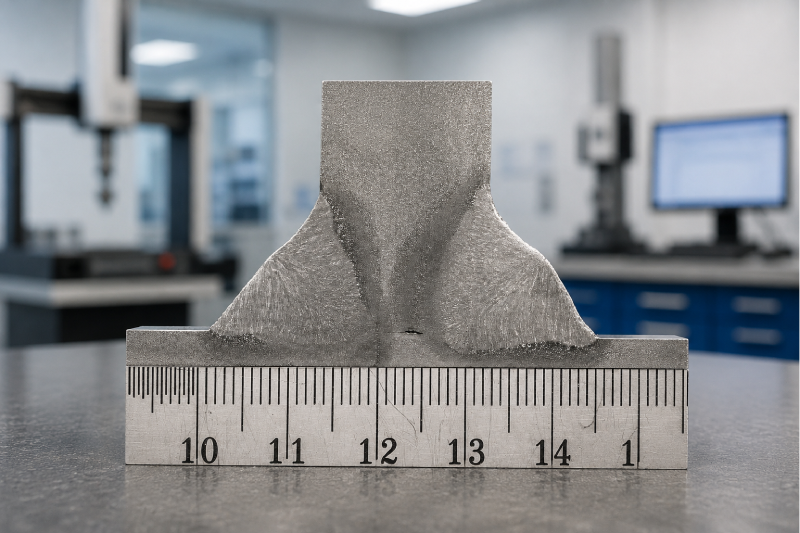
A weld penetration inspection system is designed to measure and analyze the depth, fusion, and geometry of a weld—with high precision.
Instead of guessing or relying only on post-weld testing, these systems:
- Capture high-resolution images of weld cross-sections
- Measure penetration depth, angle, and fusion
- Provide accurate, repeatable data
- Generate digital reports for audits
This makes penetration in welding measurable, not assumable.
Why Welding Penetration Inspection is a Game-Changer for Rail & Metro Projects?
1. Early Defect Detection (Before It Becomes Costly)
Imagine catching a weld defect before the component is installed.
That’s exactly what penetration inspection enables.
Instead of waiting for ultrasonic or radiographic testing, you can:
- Validate weld quality at the lab or production stage
- Prevent defective components from reaching the site
Result: Zero surprises during final inspection
2. Improved Safety Across Infrastructure
In railway and metro systems, safety isn’t negotiable.
By ensuring proper penetration welding, you:
- Reduce risk of weld failure
- Increase structural integrity
- Ensure long-term reliability
This is especially critical for:
- Railway tracks
- Metro structural frameworks
- Rolling stock components
3. Faster Compliance with Industry Standards
Audits can be stressful—unless you’re prepared.
Weld penetration inspection systems help you:
- Maintain digital inspection records
- Standardize measurement criteria
- Ensure traceability for every weld
This makes compliance with:
- ISO 3834
- EN 15085
much smoother and faster.
4. Reduced Rework and Project Delays
Rework is one of the biggest hidden costs in infrastructure projects.
By improving weld inspection accuracy, you:
- Minimize rejection rates
- Avoid repeated welding cycles
- Keep projects on schedule
Result: Better margins and faster delivery
5. Data-Driven Decision Making
Modern inspection systems don’t just measure—they provide insights.
You can:
- Analyze trends in weld quality
- Identify recurring defects
- Improve welding processes over time
This shifts your approach from:
Reactive → Proactive → Predictive
Where It Fits in Your Inspection Workflow?
A common misconception is that weld penetration inspection replaces NDT.
It doesn’t—it enhances it.
Ideal Workflow:
- Pre-NDT Stage
- Use weld penetration inspection system
- Validate weld geometry and penetration
- NDT Stage
- Ultrasonic / Radiography testing
- Detect internal defects
- Final Validation
- Documentation & compliance
This layered approach ensures maximum quality assurance
How to Choose the Right Weld Penetration Inspection System?
If you’re evaluating solutions, here’s what to look for:
✔ Accuracy & Measurement Capability
- Can it measure all key weld parameters?
✔ Ease of Use
- User-friendly interface for operators
✔ Reporting & Documentation
- Digital reports for compliance audits
✔ Customization
- Supports different weld types and standards
✔ Industry Experience
- Proven track record in industrial applications
Real Value for Each Stakeholder
- QA Managers: Better control over weld quality
- Project Managers: Fewer delays and rework
- Engineers: Accurate, reliable measurements
- Procurement Teams: Higher ROI on quality systems
- NDT Agencies: Enhanced service offerings
Conclusion
Railway and metro projects demand precision, reliability, and zero compromise on safety.
Traditional weld inspection methods alone are no longer enough.
By integrating welding penetration inspection systems, you can:
- Detect defects earlier
- Improve compliance
- Reduce costs
- Deliver safer infrastructure
In an industry where failure is not an option, precision inspection becomes a competitive advantage.
FAQs
What is welding penetration in simple terms?
It refers to how deeply the weld fuses into the base material, ensuring joint strength and durability.
Why is weld penetration important in railway projects?
Because poor penetration can lead to weak joints, cracks, and potential failures under heavy loads.
Is weld penetration inspection a replacement for NDT?
No, it complements NDT by detecting issues earlier in the process.
Can it reduce rejection rates?
Yes, by identifying defects early, it significantly reduces rework and rejection.
Who should use weld penetration inspection systems?
QA teams, welding engineers, NDT agencies, and manufacturers involved in critical welding applications.