


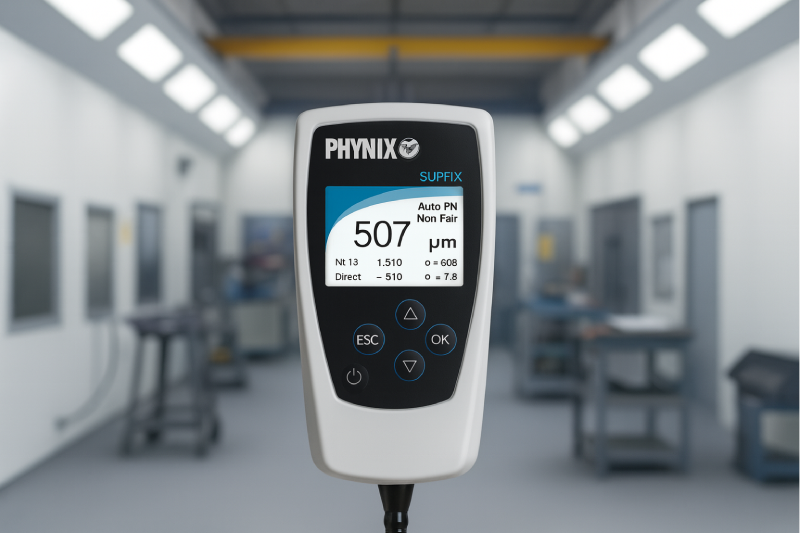
In every industry where metal parts, structures, or finished products are coated, the quality of that coating determines the durability, appearance and performance of the final product. Whether it’s automotive paint, powder-coating on machinery, galvanizing on steel parts or plating on precision components—consistent coating thickness is essential.
This is exactly where a coating thickness gauge, also known as a thickness gauge, thickness gauge paint tester, coating thickness tester, or DFT meter, becomes an indispensable quality-control tool. It allows inspectors, technicians and manufacturers to accurately measure coating thickness without damaging the surface, ensuring every product meets the right standard before it reaches the customer.
What Is a Coating Thickness Gauge?
A coating thickness gauge is a handheld or probe-based instrument used to measure the dry film thickness (DFT) of coatings applied on ferrous and non-ferrous metals. These coatings may include –
- Automotive paints
- Powder coatings
- Zinc or hot-dip galvanizing layers
- Electroplating
- Industrial protective coatings
- Enamel or varnish layers
A high-quality dft meter uses measurement principles like magnetic induction or eddy current so that readings are accurate, repeatable and non-destructive.
Why Coating Thickness Matters in Industrial Coatings
1. Ensures Long-Term Corrosion Protection
Coatings protect metal surfaces from rust and environmental damage.
- Too thin, and the coating fails early.
- Too thick, and the coating may crack, peel or trap solvents.
A thickness gauge helps ensure the coating is applied at the correct level for optimal protection.
2. Improves Surface Finish and Appearance
In industries like automotive or consumer goods manufacturing, finish quality affects brand reputation and customer perception.
Uneven paint thickness can lead to –
- Orange peel texture
- Color mismatch
- Unbalanced gloss levels
- Visible defects
Using a thickness gauge paint tester during and after painting ensures every part has a uniform, professional finish.
3. Avoids Waste and Saves Material Costs
Coating materials—paint, powder, plating chemicals—are expensive.
Applying more than required leads to –
- Higher production costs
- Longer curing time
- Material wastage
A coating thickness gauge ensures efficient usage, reducing cost while maintaining quality.
4. Prevents Product Rejections and Rework
Incorrect coating thickness is one of the top reasons for quality rejections in manufacturing.
With a coating thickness tester, issues are identified on the spot, preventing –
- Batch-level failures
- Scrapped components
- Delays in delivery
- Costly rework or repainting
How Coating Thickness Gauges Improve Quality Control
1. Ensures Consistency Across Production Batches
Quality consistency is essential, especially when dealing with OEMs or export clients.
A dft meter allows inspectors to check random samples, full batches or 100% inspection depending on the requirement.
2. Enables Traceability and QC Documentation
Modern coating thickness testers come with –
- Data storage
- Reporting features
- Bluetooth or app connectivity
This makes real-time inspection and documentation easier for quality audits.
3. Faster Decision-Making During Production
Instant measurement gives immediate feedback to painters, operators or plating technicians.
This helps in adjusting parameters before the full batch is affected.
Typical Industrial Use-Cases of Coating Thickness Gauges
1. Automotive Painting & Body Repair Centres
Technicians use a thickness gauge paint tester to ensure OEM cars have correct paint thickness and to assess re-painted surfaces during repairs.
2. Metal Fabrication Units
Powder-coated parts must meet exact thickness requirements to maintain durability and surface finish.
3. Galvanizing Plants
Zinc coatings protect steel from corrosion. A coating thickness gauge ensures the zinc layer meets ISO standards.
4. OEM Manufacturing & Component Suppliers
From electronic components to heavy machinery parts, every product must meet client coating thickness specifications.
5. Industrial Quality Audits & Third-Party Inspection Agencies
Inspectors rely on a coating thickness tester to validate coating jobs before approving final delivery.
How to Choose the Right Coating Thickness Gauge?
If you’re planning to invest in a coating thickness gauge, here is a clear and simple checklist to help you pick the right one –
1. Substrate Compatibility
Choose a gauge that measures on –
- Ferrous metals (F)
- Non-ferrous metals (N)
- Or both (F/N combined gauge)
2. Type of Coating
Different coatings require different probe technologies. Ensure it supports your coating—paint, powder coat, plating, galvanized layers, etc.
3. Accuracy & Resolution Required
For industrial applications, high accuracy is essential. Check the gauge’s measurement range, repeatability and resolution.
4. Probe Type
Depending on parts being measured –
- Built-in probe
- External probe
- Specialized probes for curved or small surfaces
5. Calibration Support
A good dft meter must support zero calibration, foil calibration and multi-point calibration.
6. Ease of Use & Portability
Choose a device that is –
- Lightweight
- Simple to operate
- Clear display with fast reading response
7. Data Storage & Reporting
If you need QC documentation, choose a gauge that supports –
- Memory storage
- USB/Bluetooth connectivity
- Reporting software