


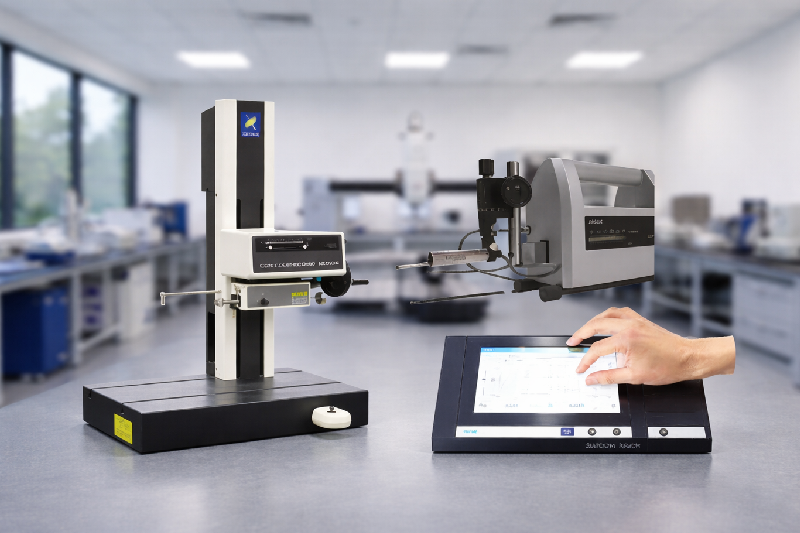
In today’s precision-driven manufacturing environment, even the smallest surface variation can significantly impact product performance, reliability, and lifespan. Surface roughness and contour measurement are essential inspection processes used to verify both surface texture and overall component geometry. These measurements help manufacturers maintain quality consistency, reduce defects, and ensure compliance with international standards across industries such as automotive, aerospace, medical devices, and precision engineering.
Understanding Surface Texture - Roughness, Waviness, and Form
Surface texture is a combination of multiple elements that influence a component’s functional behavior. To ensure accurate inspection, it is important to distinguish between roughness, waviness, and form.
- Surface Roughness refers to fine, closely spaced irregularities created by machining processes such as grinding, milling, turning, or polishing.
- Waviness consists of larger, widely spaced deviations typically caused by machine vibration, tool wear, or thermal effects.
- Form (Contour) represents the overall shape or profile of a component, including straightness, roundness, angles, and radii.
Accurate surface roughness and contour measurement allow manufacturers to separate these elements using advanced filtering techniques and analyze each characteristic independently.
What Is Surface Roughness Measurement?
Surface roughness measurement evaluates the micro-level texture of a surface that directly affects friction, wear, lubrication, sealing efficiency, and fatigue strength. Even when a part appears smooth to the naked eye, microscopic irregularities can impact its performance during operation.
Common roughness parameters include –
- Ra (Arithmetic Mean Roughness) – The most widely used parameter for general surface quality assessment.
- Rz (Average Maximum Height) – Measures the average peak-to-valley height, critical for sealing and contact surfaces.
- Rq (Root Mean Square Roughness) – More sensitive to extreme peaks and valleys than Ra.
- Rt (Total Height of Profile) – Indicates the maximum vertical distance across the evaluation length.
Selecting the correct roughness parameter ensures accurate functional evaluation and process control.
What Is Contour Measurement?
Contour measurement focuses on the macro-level geometry of a component by evaluating its profile and shape against nominal design values. It is essential for verifying complex geometries and tight tolerances that cannot be assessed using roughness measurement alone.
Contour measurement helps assess –
- Radii and chamfers
- Angles and slopes
- Groove depth and step height
- Straightness and profile deviation
Accurate contour measurement ensures proper fit, assembly accuracy, and dimensional compliance in precision components.
Difference Between Surface Roughness and Contour Measurement
Although related, surface roughness and contour measurement serve different inspection purposes.
Aspect | Surface Roughness | Contour Measurement |
Measurement Scale | Micro-level texture | Macro-level profile |
Key Focus | Functional surface quality | Shape and geometry accuracy |
Typical Parameters | Ra, Rz, Rq, Rt | Radius, angle, profile deviation |
Functional Impact | Wear, friction, sealing | Fit, alignment, dimensional accuracy |
Both measurements are complementary and often required together for complete quality assessment.
Measurement Methods and Instruments
Surface roughness and contour measurement are commonly performed using stylus-based profilometers and contour measuring instruments. These systems use a high-precision probe to trace the surface and capture vertical and horizontal profile data.
Modern measurement systems offer –
- High-resolution sensors for accurate data capture
- Combined roughness and contour measurement in a single setup
- Advanced software for profile analysis and reporting
- Compliance with ISO and international standards
These capabilities ensure repeatable, reliable inspection results across different production environments.
Role of Software in Surface Roughness and Contour Measurement
Software plays a crucial role in transforming raw measurement data into meaningful insights. Advanced analysis software enables –
- Automatic filtering and parameter calculation
- Profile fitting and form removal
- Graphical visualization of measured profiles
- Tolerance comparison with pass/fail results
- Customizable and traceable inspection reports
This reduces operator dependency, improves repeatability, and supports quality audits.
Contact vs Non-Contact Measurement Techniques
Understanding available measurement techniques helps manufacturers select the right solution.
Contact Measurement (Stylus-Based)
- High accuracy and repeatability
- Ideal for both surface roughness and contour measurement
- Suitable for most industrial components and materials
Non-Contact Measurement (Optical Methods)
- Faster inspection for sensitive or soft surfaces
- No physical contact with the component
- Limited performance on steep slopes or deep grooves
For most precision manufacturing applications, contact-based measurement remains the preferred and most reliable approach.
Importance of Surface Roughness and Contour Measurement in Quality Control
Poor surface quality or inaccurate contour can result in –
- Premature component wear or failure
- Increased friction and energy loss
- Poor sealing and leakage
- Assembly and alignment issues
By integrating surface roughness and contour measurement into quality control workflows, manufacturers can reduce rework, improve process stability, and enhance overall product performance.
Best Practices for Accurate Measurement
To achieve consistent and reliable results, manufacturers should follow best practices such as –
- Cleaning surfaces before measurement
- Selecting the appropriate stylus and measurement parameters
- Maintaining stable environmental conditions
- Performing regular instrument calibration
- Using trained operators and standardized procedures
These practices ensure measurement accuracy and long-term reliability.
Applications Across Industries
Surface roughness and contour measurement are widely used in –
- Automotive – Engine components, brake systems, transmission parts
- Aerospace – Turbine blades, structural components
- Medical Devices – Implants, surgical tools
- Tooling & Mold Making – Dies, molds, precision tooling
- General Engineering – Bearings, shafts, seals
Each industry relies on accurate measurement to meet strict quality and safety standards.
Why Choose QS Metrology for Surface Roughness and Contour Measurement?
QS Metrology provides high-precision surface roughness and contour measurement solutions tailored to modern manufacturing requirements. With advanced measuring instruments, expert technical support, and reliable after-sales service, QS Metrology helps manufacturers achieve consistent inspection accuracy and regulatory compliance.
From solution selection and installation to calibration and application support, QS Metrology is your trusted partner for precision surface measurement.