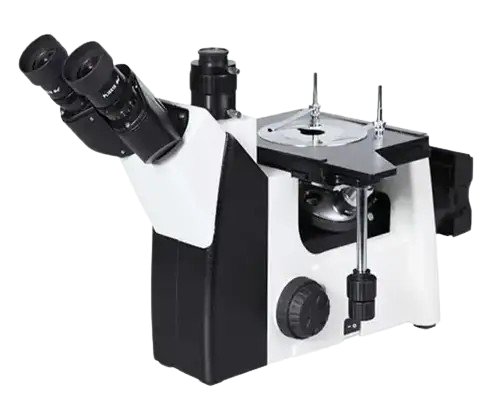
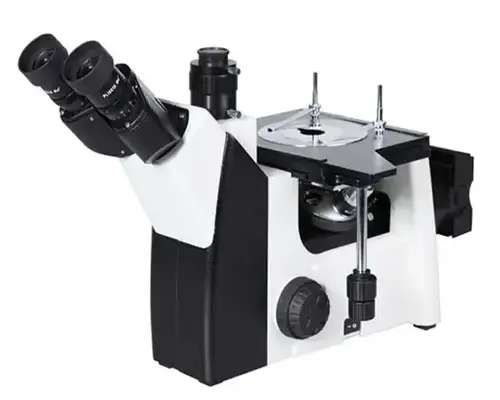
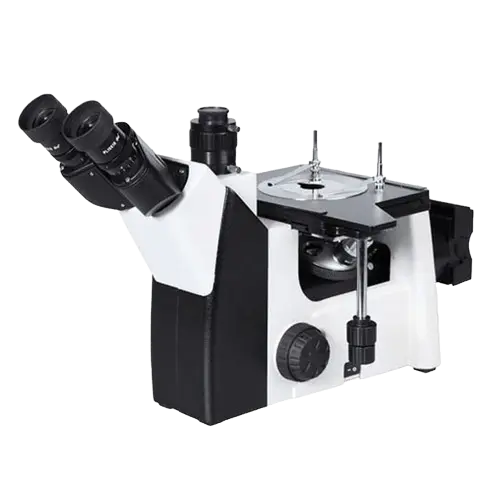
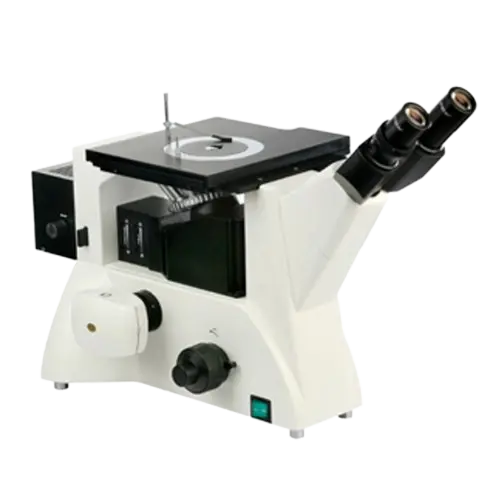
Metallurgical microscopes are used for the Metallographic studies of Metals. With our Metallurgical Image Analysis Software (MIAS®) and USB Camera, they are ideal solutions to your Metallographic analysis needs.
We have 2 models of Metallurgical microscopes – IE200M and MJ6408, both Inverted Trinocular models
Key Features of Metallurgical Microscopes
Reflected Light Illumination System
High‑Resolution Infinity Optical Lenses
Polarizers & Contrast Enhancing Techniques
Robust, Vibration‑Free Mechanical Stage
Digital Imaging & Measurement Software Compatibility
Metallurgical microscopes use reflected light to examine opaque materials such as metals and alloys, allowing detailed observation of surface features. Light is directed from above and reflected into high‑resolution objective lenses to capture fine microstructures. Advanced contrast techniques like darkfield or polarized light enhance visibility of grain boundaries and defects. The stable mechanical stage ensures precise positioning and focus of the sample. Users can view the specimen directly through eyepieces or capture images digitally for documentation. This makes metallurgical microscopes essential for material analysis, quality control, and research applications.
Locations We Serve
QS Metrology provides Metallurgical Microscopes across India, serving all major industrial regions, including:
It is used to examine opaque materials like metals, alloys, ceramics, and composites to study microstructures, grain boundaries, and defects.
They primarily use reflected (incident) light, often combined with polarizers, darkfield, or differential interference contrast (DIC) for enhanced visibility.
Yes, most modern models support camera attachment or integrated digital imaging systems for documentation and analysis.
Typical magnification ranges from 50× to 1000×, depending on the objective lenses and eyepiece combinations.
Yes, they are widely used in quality control, material testing, metallurgy research, and failure analysis.
Clean lenses with a soft lens cloth, keep the stage and sample area dust-free, and avoid harsh chemicals to ensure long-term performance.
Industries We Serve
Automotive
Medical Device & Pharmaceutical
Aerospace
Electronic & Electric Component
Chemicals & Petrochemicals
Metal Foundries & Casting
Energy, Power & Renewables
Mining & Minerals
Looking for a Custom Measurement Solution?
Our experts will guide you to the right technology.