


Accurate material identification and elemental composition analysis are fundamental requirements in modern material science. From quality assurance and failure analysis to regulatory compliance and incoming inspection, measurement accuracy directly impacts product reliability and manufacturing efficiency. Among non-destructive testing technologies, X-ray fluorescence spectroscopy has become a cornerstone technique for rapid and reliable elemental analysis across industries.
However, one key decision often challenges quality engineers and material science managers – Should you use handheld XRF analyzers or benchtop XRF spectrometers? While both rely on the same scientific principle of X-ray fluorescence analysis (XRF), their measurement capabilities, accuracy levels, and use cases differ significantly. This guide explains those differences from a strictly material science-centric perspective to help you choose the right solution for precise material analysis.
Understanding X-Ray Fluorescence Spectroscopy
X-ray fluorescence spectroscopy is a non-destructive analytical method used to determine the elemental composition of materials. When a material is exposed to primary X-rays, atoms within the sample emit secondary (fluorescent) X-rays with characteristic energies. These energies are measured and converted into qualitative and quantitative elemental data.
In material science applications, X-ray fluorescence analysis (XRF) is valued for its –
- High repeatability
- Minimal sample preparation
- Non-destructive measurement
- Fast inspection cycles
- Broad elemental detection range
XRF is widely used in metallurgy, aerospace, automotive manufacturing, electronics, coatings, mining, and regulatory testing.
Handheld XRF Analyzers - Field-Ready Measurement Tools
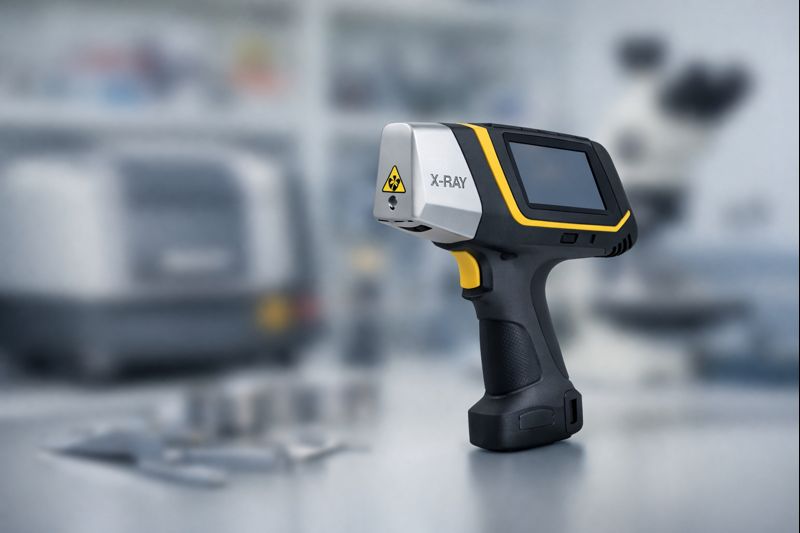
Handheld XRF analyzers are portable instruments designed for on-site material identification and rapid screening. They are extensively used where mobility and speed are critical.
Advantages
Handheld XRF analyzers enable –
- Immediate material verification in the field
- Rapid alloy identification
- Sorting of metals and scrap materials
- Preliminary quality checks during production
- Compliance verification (RoHS, REACH)
These devices are optimized for quick decision-making rather than high-precision laboratory analysis.
Measurement Characteristics
From a material science standpoint, handheld XRF analyzers typically offer –
- Moderate measurement accuracy
- Short analysis times (seconds)
- Limited control over environmental variables
- Reduced sensitivity for light elements
- Higher measurement uncertainty compared to lab systems
While modern handheld units have improved calibration algorithms, their results are best suited for screening and classification, not certification-grade measurements.
Benchtop XRF Spectrometers - Precision-Driven Instruments
Benchtop XRF spectrometers are laboratory-based systems engineered for high-accuracy and repeatable measurements under controlled conditions. These instruments are widely used in material science labs, quality control departments, and research environments.
Advantages
Benchtop systems deliver –
- Superior measurement precision and repeatability
- Enhanced detection limits for trace elements
- Controlled sample positioning and geometry
- Advanced calibration and correction models
- High confidence quantitative results
For applications requiring documented accuracy and traceability, benchtop XRF spectrometers are the preferred solution.
Measurement Characteristics
In material science applications, benchtop XRF systems provide –
- Lower measurement uncertainty
- Improved sensitivity for light and heavy elements
- Stable operating conditions
- Consistent results across large sample batches
- Compliance with international testing standards
These capabilities make benchtop instruments ideal for certified material analysis, laboratory QA, and failure investigation.
Accuracy vs Portability
| Parameter | Handheld XRF Analyzers | Benchtop XRF Spectrometers |
| Measurement accuracy | Moderate | High |
| Repeatability | Limited | Excellent |
| Environmental control | Minimal | Full |
| Portability | High | None |
| Sample preparation | Minimal | Optional but recommended |
| Certification | Not ideal | Suitable |
Application-Based Selection in Material Science
Choosing between handheld and benchtop XRF should be guided by measurement objectives rather than convenience alone.
Use Handheld XRF Analyzers When –
- On-site inspection is required
- Fast material identification is needed
- Sorting and screening tasks dominate
- Production environments limit lab access
- Preliminary inspection precedes lab testing
Use Benchtop XRF Spectrometers When –
- High-accuracy quantitative analysis is required
- Measurement traceability matters
- Regulatory or customer certification is needed
- Batch testing consistency is critical
- Advanced elemental analysis is performed
In many industrial material science setups, both systems coexist, serving complementary roles.
Role of XRF in Modern Quality Control
X-ray fluorescence analysis (XRF) plays a crucial role in preventing material mix-ups, detecting composition deviations, and ensuring compliance with international standards. Inconsistent alloy chemistry or coating thickness errors can lead to structural failure, product recalls, and financial losses.
By integrating the correct XRF system into a material science workflow, manufacturers can –
- Improve inspection confidence
- Reduce rework and scrap
- Maintain compliance with ISO and industry standards
- Strengthen traceability and documentation
Final Thoughts
Both handheld XRF analyzers and benchtop XRF spectrometers are indispensable tools within modern material testing environments. The decision should always be based on measurement accuracy requirements, inspection environment, and quality objectives.
For rapid field decisions and process-level checks, handheld instruments deliver unmatched convenience. For laboratory-grade precision and traceable results, benchtop XRF remains the gold standard in X-ray fluorescence spectroscopy.