


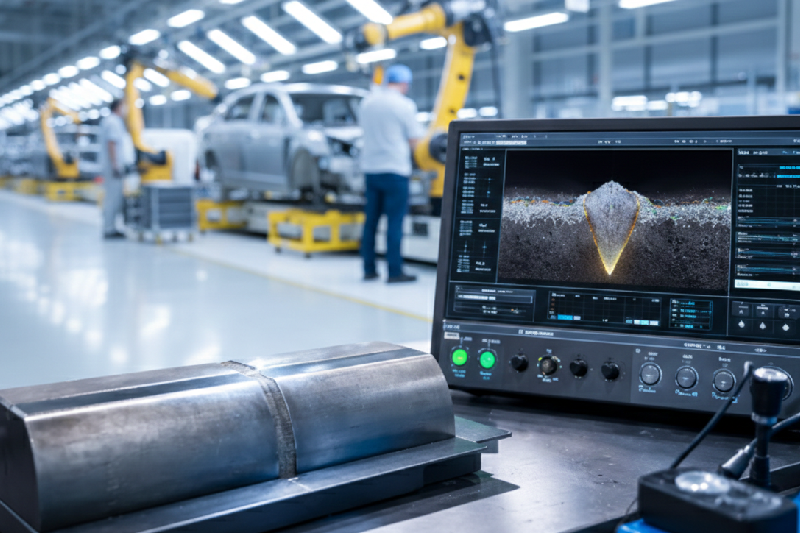
India’s automotive sector is one of the fastest-growing in the world. From passenger cars and commercial vehicles to electric vehicles (EVs), Indian manufacturers are expanding production capacity and focusing heavily on quality, durability, and safety. In this competitive environment, weld penetration and advanced weld inspection systems play a critical role in ensuring structural strength and long-term performance.
For Indian automotive businesses, maintaining proper welding penetration is not just a quality requirement—it is a safety necessity and a compliance obligation.
Understanding Weld Penetration in Automotive Manufacturing
Weld penetration refers to how deeply the weld metal fuses into the base material during the welding process. In automotive manufacturing, proper penetration of welding determines whether a joint can withstand stress, vibration, and impact.
Automotive components such as –
- Chassis frames
- Suspension mounts
- Body-in-white (BIW) structures
- Engine brackets
- Exhaust systems
require precise welding full penetration to ensure load-bearing strength. If weld penetration is insufficient, it can lead to cracks, joint failure, and even safety hazards during collisions.
For Indian OEMs and auto component manufacturers, achieving consistent welding penetration across thousands of vehicles daily is a major challenge. This is where automated weld inspection systems become essential.
Why Weld Penetration Matters for Indian Automotive Industry?
India is home to leading automotive manufacturers such as Tata Motors, Mahindra & Mahindra, and Maruti Suzuki. These companies operate large-scale production facilities where even minor welding defects can result in massive recall costs.
Proper weld penetration ensures –
- Structural integrity of vehicle frames
- Enhanced crash resistance
- Improved durability in Indian road conditions
- Reduced warranty claims
- Compliance with AIS and global automotive standards
Indian roads present unique challenges—potholes, heavy loads, temperature variations, and rough terrains. In such conditions, weak penetration of welding can lead to premature structural fatigue.
Therefore, maintaining consistent welding full penetration across critical components directly impacts brand reputation and customer safety.
Common Weld Penetration Defects in Automotive Manufacturing
Despite automation, several issues can affect weld penetration –
- Incomplete penetration
- Lack of fusion
- Excessive penetration
- Porosity
- Cracking
Incomplete welding penetration is especially dangerous in automotive chassis welding. It reduces load-carrying capacity and increases the risk of joint failure during impact.
Indian Tier-1 and Tier-2 auto component suppliers must implement strict weld inspection protocols to detect these defects before assembly.
Role of Weld Inspection Systems
Modern weld inspection systems are designed to evaluate the quality and depth of weld penetration in real time. These systems help manufacturers maintain uniform penetration of welding across production batches.
Common inspection methods used in Indian automotive plants include –
- Ultrasonic Testing (UT) – Used to check internal welding penetration and detect hidden defects.
- Radiographic Testing (RT) – X-ray-based inspection to verify welding full penetration in critical joints.
- Visual & AI-Based Inspection – Advanced camera systems analyze weld beads to ensure correct weld penetration and surface quality.
- Destructive Testing (DT) – Used during sample validation to verify penetration of welding meets required strength parameters.
With Industry 4.0 adoption increasing in India, automated weld inspection systems are now integrated with robotics and production lines, ensuring zero-defect manufacturing.
Impact on Electric Vehicle (EV) Manufacturing in India
The EV segment is rapidly growing, supported by government initiatives like FAME II and Make in India. EV battery enclosures, lightweight aluminum frames, and motor assemblies require precise welding penetration control.
Unlike conventional steel welding, aluminum welding demands controlled heat input to achieve proper welding full penetration without distortion. Poor penetration of welding in EV battery housings can compromise safety.
Therefore, EV manufacturers are investing heavily in advanced weld inspection technologies to maintain quality and prevent fire risks.
Cost Benefits of Proper Weld Penetration & Inspection
Many Indian MSME auto manufacturers view inspection systems as an added expense. However, the long-term benefits outweigh the initial investment.
Proper weld penetration and regular weld inspection help in –
- Reducing production rework
- Minimizing scrap rates
- Preventing costly recalls
- Lowering warranty claims
- Enhancing export compliance
With India exporting vehicles globally, maintaining international welding standards is crucial. Consistent welding penetration ensures global competitiveness.
Automation & Robotics in Automotive Welding
Robotic welding systems are widely used in Indian automotive plants. However, automation alone does not guarantee correct weld penetration. Real-time monitoring and weld inspection are necessary to validate every weld.
Smart factories now use –
- Laser-based penetration sensors
- AI-powered weld bead analysis
- Data-driven quality dashboards
These technologies ensure optimal penetration of welding and consistent welding full penetration across high-volume production lines.
Compliance & Quality Standards in India
Indian automotive manufacturers must adhere to strict quality guidelines under Automotive Industry Standards (AIS). Achieving proper weld penetration is essential to meet these standards.
Export-oriented manufacturers must also comply with global welding norms. Effective weld inspection ensures documentation, traceability, and certification readiness.
Future of Weld Inspection in Indian Automotive Industry
As India moves toward becoming a global automotive hub, demand for advanced weld inspection systems will grow significantly.
Key trends include –
- AI-based defect detection
- Real-time penetration monitoring
- Integration with ERP and quality management systems
- Increased focus on lightweight materials
Consistent weld penetration and reliable welding penetration control will remain at the core of automotive manufacturing excellence.
In the Indian automotive industry, weld penetration is directly linked to vehicle safety, structural strength, and brand credibility. Whether it is passenger cars, commercial vehicles, or EVs, proper welding full penetration ensures durability and performance.
Advanced weld inspection systems help manufacturers maintain optimal penetration of welding, reduce defects, and meet compliance standards. For Indian businesses aiming to scale production and compete globally, investing in robust welding penetration control and inspection technology is no longer optional—it is essential.