India’s manufacturing sector has grown rapidly over the last decade, with industrial clusters developing across multiple regions. From automotive manufacturing to aerospace engineering, industries are focusing more on precision, durability, and quality control to stay competitive in both domestic and global markets.
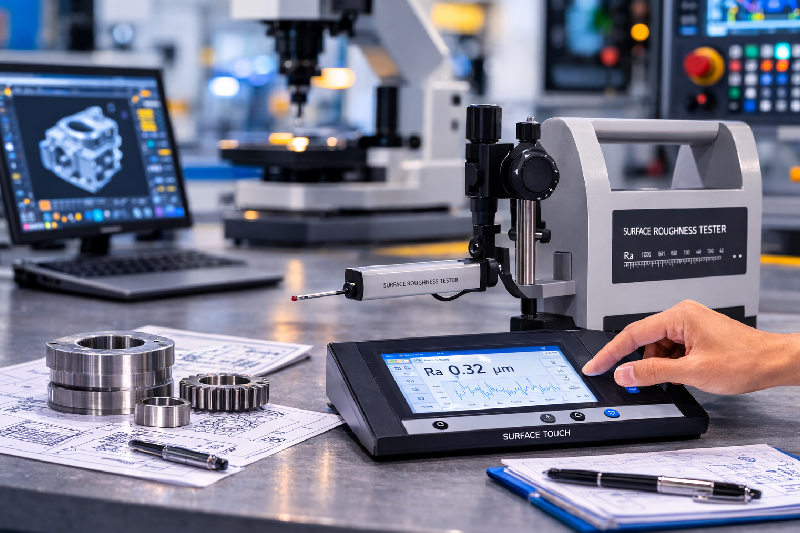
To maintain strict quality standards, companies widely use surface roughness measuring instruments, surface roughness measurement equipment, and RA testers to inspect machined parts and finished components. In India, several major industrial sectors rely heavily on these tools for quality assurance.
Below are the top industries where the surface roughness tester plays a crucial role in production quality control.
The automotive components industry is one of the largest users of surface roughness testers in India. Automotive parts require extremely precise finishing because the efficiency of engines, transmissions, and braking systems depends heavily on the surface quality of components.
Major automotive manufacturing clusters are located in cities such as Gurugram, Manesar, Faridabad, and Noida in North India. These cities host hundreds of automotive OEM suppliers and component manufacturers that supply parts to major automobile brands.
Manufacturers producing parts such as engine pistons, crankshafts, camshafts, gears, and bearings rely on surface roughness measurement equipment to inspect the surface finish of critical components. If a surface is too rough, it can cause friction, heat generation, and faster wear of mechanical parts.
CNC machining industries are another major segment where surface roughness testers are widely used. CNC machines are designed for high-precision manufacturing, producing components that must meet extremely tight dimensional and surface finish requirements.
Important CNC machining hubs in North India include Ghaziabad, Faridabad, Ludhiana, and Delhi NCR. These cities are home to thousands of small and medium engineering units that manufacture precision components for automotive, industrial machinery, and engineering equipment.
During machining operations such as turning, milling, drilling, and grinding, the final surface quality of the component must be carefully inspected. This is where surface roughness measurement equipment becomes essential.
Machine shops often use a surface roughness tester to evaluate the smoothness of machined surfaces before components are delivered to clients. Precision shafts, hydraulic components, valves, and mechanical fittings are commonly tested using surface roughness measuring instruments.
Using an accurate RA tester, CNC machining companies can identify surface defects early and maintain consistent production quality. This helps manufacturers meet customer specifications and improve their credibility in the market.
The casting and forging industry forms the backbone of heavy engineering and industrial manufacturing in India. Forged and cast metal components are widely used in sectors such as construction equipment, automotive, railways, and heavy machinery.
Cities like Ludhiana, Yamunanagar, Ghaziabad, and Jalandhar are well-known hubs for casting and forging industries. These regions have a strong network of manufacturers producing metal components for domestic and export markets.
After casting or forging, components usually go through machining and finishing processes. During these stages, surface roughness measurement equipment is used to check whether the final surface meets engineering specifications.
Quality control departments frequently rely on RA testers to verify that the finished product meets the required surface finish standards before shipment.
Tool and die manufacturing is another industry where surface finish plays a critical role in determining product quality. Tools, molds, and dies are used to produce thousands of parts in mass production environments.
Major tool and die manufacturing centers in India include Faridabad, Delhi, Noida, and Gurugram. These cities host many precision engineering companies that design and manufacture molds and dies for automotive, plastic molding, and industrial production.
In this industry, the surface finish of molds and dies directly affects the quality of the final product. Any roughness on a mold surface can lead to defects in molded components.
Manufacturers use surface roughness testers to evaluate the smoothness of die surfaces during finishing and polishing processes. Advanced surface roughness measuring instruments help ensure that tools achieve the required level of smoothness.
A reliable RA tester allows quality inspectors to measure minute variations in surface finish. By using accurate surface roughness measurement equipment, tool and die manufacturers can extend tool life, improve product quality, and maintain consistency in large-scale production.
The aerospace industry demands the highest level of precision and quality assurance. Components used in aircraft engines and structural assemblies must meet extremely strict manufacturing standards.
Important aerospace manufacturing hubs in India include Bangalore, Hyderabad, and parts of the Delhi NCR region where aerospace suppliers and precision engineering companies operate.
Aerospace components such as turbine blades, aircraft engine parts, landing gear components, and structural fittings require extremely precise surface finishing. Even microscopic irregularities can impact aerodynamic performance and mechanical reliability.
To ensure compliance with aerospace quality standards, manufacturers use highly accurate surface roughness measurement equipment and surface roughness testers.
Quality inspection teams rely on advanced surface roughness measuring instruments and RA testers to measure surface parameters with precision. These tools help manufacturers ensure that aerospace components meet strict international safety and performance requirements.
Using a dependable surface roughness tester is therefore a critical part of aerospace manufacturing quality control systems.
As India’s industrial ecosystem continues to expand, manufacturers are placing greater emphasis on precision engineering and quality control. Industries such as automotive components, CNC machining, casting and forging, tool and die manufacturing, and aerospace production rely heavily on accurate surface inspection.
Cities like Gurugram, Faridabad, Noida, Ghaziabad, Ludhiana, and Yamunanagar have become major manufacturing hubs where the use of surface roughness testers is increasingly common.
For modern industrial manufacturers, the surface roughness tester has become an essential tool for achieving precision, improving product performance, and ensuring long-term manufacturing excellence.