


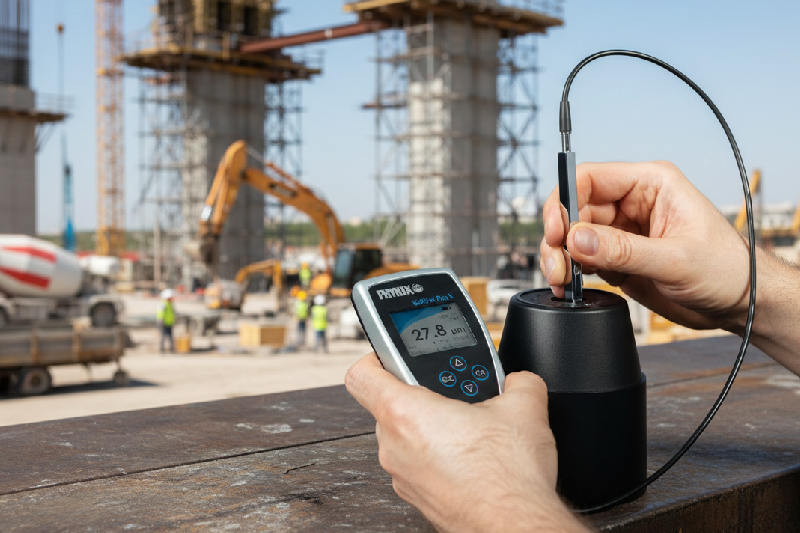
India’s construction and infrastructure sector is expanding rapidly — from expressways and metro rail corridors to smart cities, industrial corridors, refineries, power plants, and high-rise commercial towers. With such massive capital investment involved, durability and long-term performance are no longer optional — they are mandatory.
One small but critical instrument that ensures this durability is the coating thickness gauge, commonly known in the industry as a DFT meter (Dry Film Thickness meter). For Indian EPC contractors, infrastructure developers, PMC consultants, and QA/QC teams, using a reliable coating thickness gauge is now a standard quality control practice.
Let’s understand why.
The Rising Need for Corrosion Protection in India
India’s climate conditions are diverse and often aggressive –
- Coastal humidity in Mumbai & Chennai
- Industrial pollution in Delhi NCR
- High rainfall in Kerala & Northeast
- Extreme heat in Rajasthan & Gujarat
Steel structures, pipelines, bridges, transmission towers, and industrial sheds are constantly exposed to environmental stress. Without proper protective coating — and more importantly, without measuring it — corrosion becomes inevitable.
This is where a coating thickness tester plays a vital role.
Protective paints and anti-corrosion coatings must be applied within specified thickness limits. Too thin, and the surface corrodes prematurely. Too thick, and it leads to cracking, peeling, or coating failure. A thickness gauge paint inspection ensures the coating performs exactly as designed.
What is a Coating Thickness Gauge (DFT Meter)?
A coating thickness gauge or DFT meter is a precision instrument used to measure the thickness of dry paint or protective coating applied on metal surfaces.
It is widely used in –
- Structural steel fabrication
- Metro rail projects
- Oil & gas pipelines
- Power plants
- Industrial warehouses
- Government infrastructure projects
For Indian contractors, a calibrated thickness gauge is often required to comply with project specifications and tender documents.
Why It Is Essential in Modern Infrastructure Projects?
1. Ensures Compliance with Indian Standards
Government and private infrastructure projects often follow standards such as IS codes, project-specific QA/QC manuals, and international specifications.
Many tenders clearly mention coating thickness requirements in microns. Without a coating thickness gauge, contractors cannot validate compliance. A certified DFT meter ensures that documentation, inspection reports, and audit approvals are smooth.
2. Prevents Costly Rework and Project Delays
Repainting steel structures due to improper coating thickness can –
- Delay handover timelines
- Increase labor costs
- Waste expensive industrial paint
- Impact contractor reputation
Using a coating thickness tester during application helps detect issues in real time. Applicators can immediately correct undercoating or overcoating, avoiding future failures.
In large-scale projects like flyovers or refinery expansions, even minor coating defects can lead to major financial losses.
3. Enhances Asset Life & ROI
Infrastructure projects are long-term investments — often designed for 20–50 years of service life.
A properly measured coating using a coating thickness gauge ensures –
- Corrosion resistance
- Structural safety
- Reduced maintenance cycles
- Lower lifecycle costs
For Indian businesses managing industrial plants, ports, or transmission towers, this directly impacts return on investment.
4. Critical for Third-Party Inspection & PMC Approval
In many infrastructure projects, third-party inspection agencies or Project Management Consultants (PMC) conduct quality audits.
During these inspections, they rely heavily on –
- DFT readings
- Calibration certificates
- Surface preparation reports
A reliable DFT meter helps QA teams present documented proof of compliance. Without proper readings from a certified thickness gauge, approvals can be withheld.
5. Essential for Oil, Gas & Heavy Engineering Projects
India’s oil & gas sector, refineries, petrochemical plants, and heavy engineering units demand strict coating standards due to exposure to chemicals and extreme conditions.
A coating thickness tester is mandatory during –
- Pipeline coating
- Storage tank painting
- Offshore platform maintenance
- Industrial equipment fabrication
In such environments, coating failure can lead to safety hazards. Accurate measurement using a thickness gauge paint inspection process becomes a safety necessity, not just a quality step.
Competitive Advantage for Indian Fabricators & Contractors
Today, infrastructure clients prefer contractors who demonstrate professional QA/QC processes.
Owning and using a modern coating thickness gauge shows –
- Technical capability
- Commitment to quality
- Process-driven execution
- International standard compliance
For MSMEs and fabrication units bidding for larger government projects, investing in a calibrated DFT meter can significantly improve credibility.
Key Benefits of Using a Coating Thickness Gauge
✔ Accurate measurement in microns
✔ Reduced paint wastage
✔ Prevention of premature corrosion
✔ Compliance with tender specifications
✔ Improved inspection documentation
✔ Increased project reliability
Whether it is a bridge in Maharashtra, a metro rail project in Bangalore, or a solar plant in Rajasthan, a coating thickness tester ensures durability from day one.
Choosing the Right Thickness Gauge for Construction Projects
When selecting a thickness gauge, Indian businesses should consider –
- Ferrous and non-ferrous compatibility
- Calibration certification
- Accuracy range
- Ease of use on-site
- Battery life and ruggedness
- After-sales service in India
A reliable DFT meter designed for Indian field conditions — dust, heat, and rough handling — ensures long-term usability.
Modern construction and infrastructure projects in India demand precision, durability, and accountability. Protective coatings are the first line of defense against corrosion — but their effectiveness depends entirely on correct thickness.
A coating thickness gauge is no longer just an optional inspection tool. It is a critical quality control instrument for every serious contractor, infrastructure developer, fabrication unit, and engineering company.
From bridges and metro stations to pipelines and power plants, a certified DFT meter, reliable thickness gauge, accurate thickness gauge paint inspection, and professional use of a coating thickness tester ensure projects stand strong for decades.