


In modern manufacturing, precision is no longer an option — it is a necessity. Whether you are producing automotive components, machined parts, aerospace assemblies, moulded products or industrial tools, surface finish directly affects performance, durability, and overall product quality. Even the smallest surface irregularity can influence how a component wears, fits, seals, or interacts with other parts.
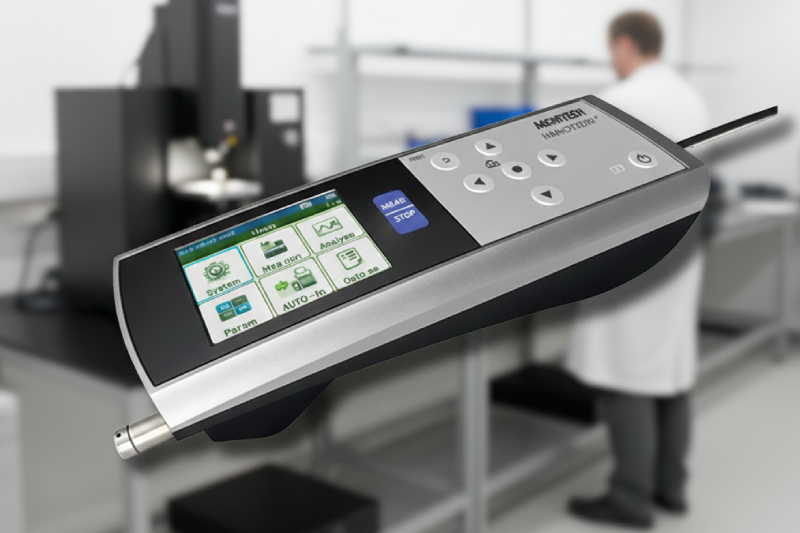
This is where surface roughness measurement becomes essential. By accurately checking how smooth or textured a surface is, manufacturers can control quality at every stage — from machining and grinding to polishing and coating. And among the various instruments used in the industry, a portable Ra tester has become one of the most important tools for quick, reliable, shop-floor inspection.
In this blog, we’ll break down why surface finish matters, how roughness affects real-world performance, and why a portable surface roughness tester is crucial for today’s fast-paced manufacturing environment.
1. What Is Surface Roughness and Why Does It Matter?
Surface roughness refers to the tiny peaks and valleys on a material’s surface. These irregularities might be invisible to the naked eye, but they influence how a part behaves during operation. When engineers talk about surface roughness measurement, they typically refer to parameters such as Ra, Rz, Rt, and others defined under international standards (ISO, DIN, ASME, JIS).
Why does this matter? Because surface texture affects –
- Friction and wear – Rougher surfaces cause more resistance, leading to faster wear in moving components like bearings, shafts, and gears.
- Lubrication retention – A properly controlled finish helps maintain lubrication films, improving part longevity.
- Sealing performance – Components that require tight sealing — such as hydraulic parts — need optimal finish to avoid leakage.
- Coating and plating adhesion – If the surface is too smooth or too rough, coatings may peel, blister, or fail prematurely.
- Aesthetic and functional quality – In industries like consumer electronics, moulds, or medical devices, appearance is also a critical parameter.
These are the reasons why surface roughness measurement is part of every robust quality-control process today.
2. Why Improper Surface Finish Leads to Quality Issues
Ignoring surface finish or relying on visual inspection often results in –
- Premature corrosion due to improper coating adhesion
- Uneven wear on metal-to-metal contact surfaces
- Reduced fatigue strength, especially in fasteners, aerospace parts, and structural components
- Poor fit and tolerance mismatch during assembly
- Wasted machining effort and increased rejection rates
A well-specified and well-controlled finish helps eliminate these failures early in the production cycle.
3. Where Portable Roughness Testers Make a Difference
Traditional surface measurement was mostly done using benchtop lab equipment. While extremely precise, these instruments are not always practical for shop-floor or on-site inspection.
This gap is perfectly filled by a portable Ra tester.
Key advantages –
Instant, on-the-spot measurements
Operators can check roughness directly on machines, large components, or assembled parts without transporting them to a lab.
Consistent results aligned with international standards
Modern portable testers support all major roughness parameters and standards (ISO, DIN, ASME, JIS), ensuring compliant and repeatable measurements.
Ideal for diverse materials and surfaces
From machined steel to cast components, plastic moulds, coatings and plated surfaces, portable testers handle a wide range of applications.
Reduced downtime and faster decision-making
Real-time feedback helps machinists adjust cutting speeds, feeds, tool conditions, and machining strategies.
Perfect for inspection teams and OEMs
Inspectors can use the same portable unit across multiple lines, plants, or customer sites.
These capabilities make portable roughness testers one of the most powerful tools for shop-floor surface roughness measurement.
4. Understanding Ra, Rz, and Other Roughness Parameters
Many engineers still confuse Ra, Rz and other parameters. A portable tester helps simplify this.
Ra (Roughness Average)
The most widely used parameter. It shows the average deviation of the surface profile. This is why portable testers are often called Ra testers.
Rz (Mean Roughness Depth)
Measures the average height difference between peaks and valleys across multiple sampling lengths. Useful for functional surfaces.
Rt (Total Height of Profile)
Shows the highest peak to the lowest valley within the measurement range.
Portable testers calculate these values instantly, helping operators make decisions without waiting for lab reports.
5. Applications Across Industries
Surface roughness measurement is used everywhere –
Automotive
Engine blocks, crankshafts, cylinder heads, brake components, transmission parts.
Aerospace
Landing gear, turbine parts, structural hinges, precision machined assemblies.
Tooling & Moulds
Injection moulds, die tools, jigs, and fixtures require controlled finish for durability and performance.
Metal fabrication & machining
Turning, milling, grinding, polishing, lapping operations.
Coating and plating
Galvanizing, anodizing, and powder coating require correct pre-surface preparation.
A portable Ra tester ensures all these surfaces meet the required finishing standards.
6. Why Portable Testers Provide Better Flexibility
A major advantage of portable roughness testers is their ability to measure on –
- Flat surfaces
- Cylindrical surfaces
- Curved or contoured areas
- Hard-to-reach locations
- Large or heavy components that cannot be moved
Because of their compact design, portable testers provide more flexibility than benchtop instruments.
7. Portable Surface Roughness Tester at QS Metrology
QS Metrology offers advanced portable testers designed for –
- High accuracy
- Fast measurement speeds
- Multiple roughness parameters
- Durable stylus construction
- User-friendly interface
- Compliance with ISO/DIN/ASME/JIS standards
If you need reliable surface roughness measurement on the shop floor, a QS Metrology Ra tester is the ideal choice.
Surface finish is one of the most influential factors in manufacturing quality. It dictates how a part performs, how long it lasts, how well it fits, and how effectively it resists wear and corrosion. As industries push toward higher precision and tighter tolerances, surface roughness measurement has become an essential part of modern quality control.
A portable Ra tester empowers manufacturers by delivering accurate, fast, and convenient measurements directly at the point of production. It bridges the gap between laboratory precision and shop-floor practicality, ensuring that every component meets the required standards.