


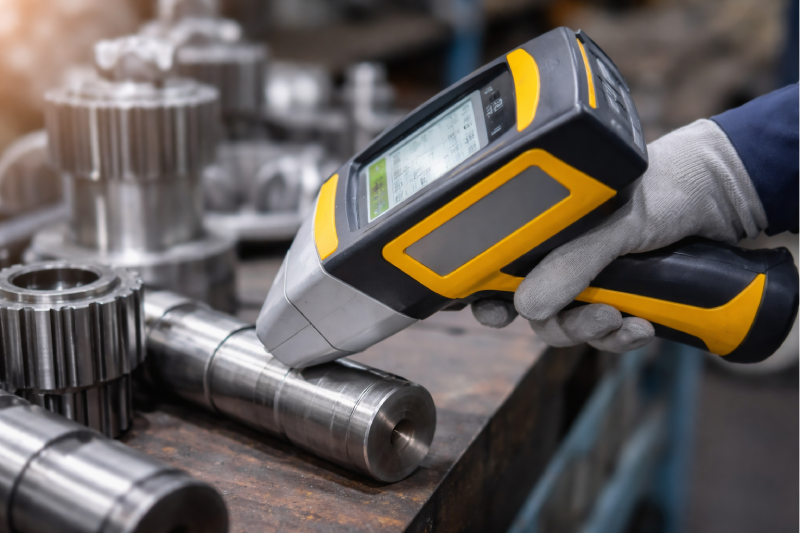
In modern metrology and material testing, speed, accuracy, and non-destructive analysis are critical. One technique that has become indispensable across industries is X-ray Fluorescence Spectroscopy, commonly known as XRF. From metals and alloys to coatings and geological samples, X-ray fluorescence analysis (XRF) plays a vital role in quality control, compliance testing, and research. However, while XRF is powerful, it is not universal. Understanding what XRF can and cannot measure is essential for selecting the right analytical method.
This article explains XRF analysis from a metrology perspective, highlighting its capabilities, limitations, and real-world applications.
What Is X-Ray Fluorescence Spectroscopy?
X-ray fluorescence spectroscopy is an elemental analysis technique used to identify and quantify elements present in a material. When a sample is exposed to high-energy X-rays, atoms inside the material emit secondary (fluorescent) X-rays at characteristic energies. These emitted energies act like fingerprints, allowing an XRF spectrometer to determine which elements are present and in what concentration.
One of the biggest advantages of X-ray fluorescence analysis XRF is that it is non-destructive. The sample remains intact, making XRF ideal for industrial inspection, heritage analysis, and quality assurance.
What Can XRF Measure?
1. Elemental Composition
XRF is best suited for detecting medium to heavy elements, typically from magnesium (Mg) to uranium (U). It is widely used for:
- Alloy identification
- Precious metal analysis
- Mining and mineral exploration
- Environmental soil testing
- Cement and construction materials
- Electronics and RoHS compliance
Both benchtop and handheld XRF analyzers can deliver fast and reliable elemental results in seconds.
2. Metals and Alloys
In metrology labs and manufacturing plants, XRF is extensively used for metal grade verification. Stainless steel, aluminum alloys, brass, bronze, and superalloys can be analyzed accurately without cutting or altering the sample.
Handheld XRF analyzers are especially valuable for on-site PMI (Positive Material Identification), scrap sorting, and incoming material inspection.
3. Coating Thickness and Plating Analysis
XRF is a trusted method for measuring coating thickness and multi-layer plating systems. Industries such as automotive, electronics, aerospace, and electroplating rely on XRF to measure:
- Zinc, nickel, chromium coatings
- Gold and silver plating
- PCB layer thickness
This makes XRF an essential tool in industrial metrology.
4. Solids, Powders, and Liquids
XRF works well with a variety of sample forms, including:
- Solid metal parts
- Powders and pellets
- Liquids in sample cups
Minimal sample preparation is required, which saves time and improves workflow efficiency.
What XRF Cannot Measure Effectively?
Despite its versatility, X-ray fluorescence spectroscopy has limitations that users must understand.
1. Very Light Elements
XRF struggles with very light elements such as:
- Hydrogen (H)
- Helium (He)
- Lithium (Li)
- Beryllium (Be)
These elements emit low-energy X-rays that are easily absorbed by air or the detector window. While advanced systems can detect elements like sodium or magnesium, ultra-light elements remain a challenge for standard XRF.
2. Chemical Bonds and Oxidation States
X-ray fluorescence analysis XRF identifies elements, not chemical structures. It cannot determine:
- Oxidation states
- Molecular bonding
- Chemical compounds
For example, XRF can detect iron (Fe) but cannot distinguish between FeO and Fe₂O₃. Techniques like XRD or FTIR are better suited for such analysis.
3. Ultra-Trace Element Detection
Although XRF offers excellent detection limits for many elements, it is not ideal for ultra-trace analysis at parts-per-billion (ppb) levels. For extremely low concentrations, methods such as ICP-MS may be required.
4. Non-Homogeneous or Rough Samples
Surface roughness, irregular geometry, or non-uniform composition can affect XRF accuracy. Proper sample preparation, calibration, and measurement geometry are essential for metrology-grade results.
Handheld vs Benchtop XRF in Metrology
Both benchtop and handheld XRF analyzers serve important roles:
- Handheld XRF analyzers are ideal for field inspections, rapid screening, and in-situ testing.
- Benchtop XRF systems provide higher precision and better control for laboratory environments.
Choosing the right system depends on application requirements, accuracy needs, and testing conditions.
Why XRF Is Critical in Modern Metrology?
XRF has become a cornerstone of material testing because it offers:
- Non-destructive analysis
- Fast results
- Minimal sample preparation
- High repeatability
- Cost-effective operation
Industries rely on trusted XRF spectrometer suppliers in India to ensure compliance with global standards, improve quality control, and reduce material failures.
Choosing the Right XRF Solution
When selecting an XRF system, it is important to work with experienced XRF spectrometer suppliers India who understand industrial metrology requirements. Factors such as calibration support, application expertise, service reliability, and training are as important as instrument specifications.
XRF analysis is a powerful, reliable, and widely used technique in metrology for elemental analysis and quality control. While X-ray fluorescence spectroscopy excels at identifying metals, coatings, and many inorganic materials, it also has clear limitations—particularly with light elements and chemical structures.
By understanding what X-ray fluorescence analysis XRF can and cannot measure, manufacturers, laboratories, and inspectors can make informed decisions and ensure accurate, repeatable results. With the right equipment and support from trusted XRF spectrometer suppliers in India, XRF continues to be an essential tool in modern industrial metrology.