


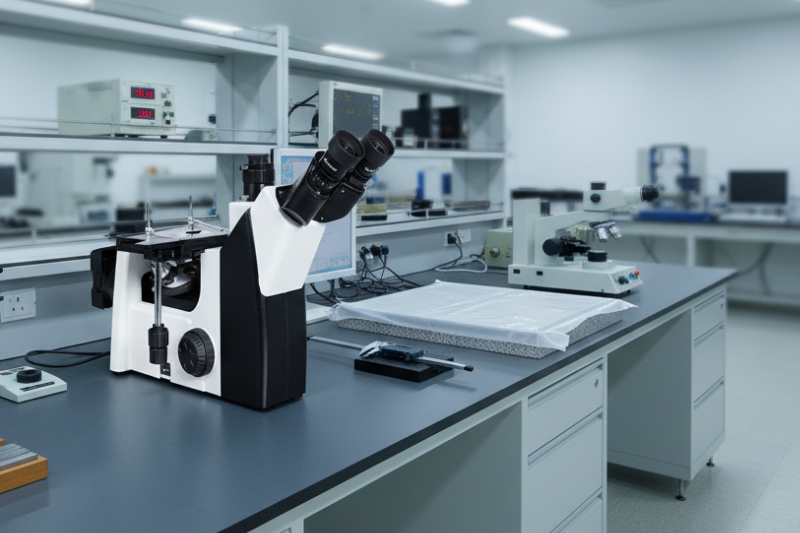
What is a Metallurgical Microscope?
A metallurgical microscope is a high-precision optical instrument designed for observing and analyzing the structure of metals and other opaque materials. Unlike a biological microscope, which uses transmitted light through transparent samples, a metallurgical microscope uses reflected light to examine solid and polished surfaces.
This unique capability allows metallurgists, engineers, and quality inspectors to study grain structure, inclusions, cracks, and other features of metal surfaces. In manufacturing and research environments, a microscope for metallurgy plays a critical role in ensuring product quality, performance, and reliability.
How a Metallurgical Microscope Works?
A metallurgical microscope works by directing light from above the sample (reflected illumination) instead of passing it through. The light reflects off the surface of the specimen and passes through the objective lenses to form a detailed image.
Here’s a step-by-step look at how it functions –
- Reflected Light Illumination – A light source above the specimen illuminates the metallic surface. This light reflects back into the objective lens for observation.
- Objective Lenses – High-quality objective lenses capture the reflected light and magnify the image. Most microscope metallurgical systems offer magnification between 50× to 1000×, suitable for analyzing grain size, inclusions, or weld structures.
- Eyepiece and Trinocular Head – The eyepiece allows direct viewing, while the trinocular head supports camera attachment for image analysis and digital documentation.
- Stage and Focus Control – The stage holds the sample securely, and the fine/coarse focus knobs adjust clarity. Smooth stage movement ensures accurate positioning of the area under inspection.
This design makes a microscope for metallurgy ideal for examining opaque materials such as metals, ceramics, and composites that cannot be viewed with traditional transmitted-light microscopes.
Key Features of a Metallurgical Microscope
A modern metallurgical microscope integrates optical precision with advanced digital imaging. Some essential features include –
- Reflected and Transmitted Illumination – For surface and transparent thin-section analysis.
- Infinity Corrected Optical System – Delivers high-contrast, flat-field images across magnifications.
- Polarization Attachments – Useful for studying crystalline structures or stress patterns in metals.
- Digital Camera Integration – Enables capturing, measuring, and analyzing microstructures.
- Ergonomic Design – Ensures comfortable, fatigue-free operation during long inspection sessions.
- Software Compatibility – Allows image measurement, comparison, and automated grain size or phase analysis.
These features make a microscope metallurgical a must-have instrument in quality control and materials laboratories.
Applications of Metallurgical Microscopes in Industry
The metallurgical microscope finds applications across multiple industries where metal quality and surface integrity are critical. Let’s look at some common use cases –
- Metallurgical Analysis – Used for microstructure evaluation of metals, studying grain boundaries, inclusions, and heat treatment effects.
- Failure Analysis – A microscope for metallurgy helps identify root causes of material failure, cracks, and corrosion by providing a detailed view of the defect area.
- Weld Inspection – Ensures weld penetration, uniformity, and defect-free joints in automotive, aerospace, and structural applications.
- Casting and Forging Quality Control – Detects porosity, surface irregularities, and non-metallic inclusions that affect product quality.
- Coating Examination – Checks coating adhesion, uniformity, and micro-cracks in plated or painted components.
- Research and Development – Used in laboratories to develop new alloys, study heat treatment effects, and conduct metallographic analysis.
By providing accurate visual evidence, a microscope metallurgical enhances quality control, reduces production waste, and improves the reliability of metal components.
Benefits of Using a Metallurgical Microscope
Using a metallurgical microscope offers several key advantages for industrial inspection and research –
- Accurate Microstructure Visualization – Enables detailed study of metal grains, phases, and inclusions.
- Non-Destructive Testing – Allows analysis of metal surfaces without damaging the sample.
- Enhanced Quality Control – Detects defects early, reducing manufacturing losses.
- Supports Research and Innovation – Facilitates study of new materials, coatings, and welding techniques.
- Digital Documentation – High-resolution image capture simplifies reporting and traceability.
These benefits make a microscope for metallurgy indispensable for foundries, automotive industries, manufacturing units, and academic research institutions.
How to Choose the Right Metallurgical Microscope?
Selecting the right metallurgical microscope depends on your inspection requirements and budget. Consider the following points before purchasing –
- Magnification Range – Choose models offering magnifications suitable for your samples (typically 50× to 1000×).
- Illumination Type – For opaque samples, ensure reflected light capability. For transparent sections, transmitted light may be needed.
- Optical Quality – Look for infinity-corrected optics for superior image clarity.
- Camera & Software Integration – A microscope metallurgical with digital compatibility improves analysis and reporting efficiency.
- Stage Type – Depending on sample size, select mechanical or large sample stages.
- Durability & Maintenance – Industrial environments require robust construction and reliable service support.
Best Practices for Metallurgical Microscopy
To achieve consistent and accurate results, follow these best practices –
- Proper Sample Preparation – Ensure smooth polishing and clean surface before observation.
- Optimal Lighting Setup – Adjust light intensity and angle for maximum contrast.
- Regular Calibration – Maintain measurement accuracy by calibrating lenses and stages periodically.
- Clean Optics – Keep lenses dust-free for clear imaging.
- Software Utilization – Use imaging software for quantitative measurement and data analysis.
By following these steps, you can maximize the performance of your microscope for metallurgy and extend its operational life.
A metallurgical microscope is more than just an inspection tool—it is a cornerstone of industrial quality assurance and research excellence. From analyzing welds and castings to developing advanced materials, a microscope metallurgical provides unmatched precision and clarity.
Whether in a manufacturing plant, quality control lab, or research institute, a microscope for metallurgy ensures every component meets the highest standards of performance and reliability.