


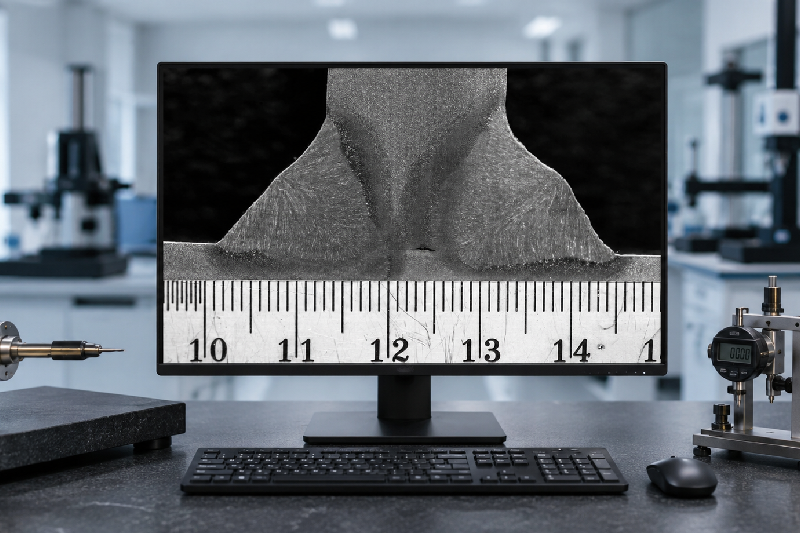
Imagine investing months into fabricating structural steel for a bridge, metro station, or industrial facility, only to discover during final inspection that several critical welds have inadequate weld penetration. The result? Costly rework, project delays, increased inspection expenses, and, in the worst cases, compromised structural integrity.
For structural steel manufacturers and EPC contractors, weld quality is far more than a production requirement—it’s a commitment to safety, compliance, and long-term performance. Every weld contributes to the strength of the finished structure, and even a small defect can have significant consequences.
This is where weld penetration inspection becomes essential. Accurate inspection helps manufacturers verify that every welded joint meets design specifications before components leave the fabrication shop or reach the construction site.
In this article, you’ll learn why weld penetration inspection is critical for infrastructure projects, how it improves quality control, reduces project risks, and why modern digital inspection systems are replacing traditional manual inspection methods.
Table of Contents
- What Is Weld Penetration?
- Why Is Weld Penetration Important in Structural Steel Fabrication?
- What Problems Are Caused by Poor Welding Penetration?
- How Does Weld Penetration Inspection Improve Infrastructure Quality?
- Manual vs Digital Weld Inspection
- How to Choose the Right Weld Inspection System
- Conclusion
- FAQs
What Is Weld Penetration?
Weld penetration refers to the depth at which molten weld metal fuses into the base material during welding. Proper penetration ensures the welded joint can withstand design loads, environmental stress, and years of continuous service.
In simple terms, deeper and uniform welding penetration creates stronger, safer, and more reliable welded joints.
For industries like infrastructure construction, structural steel fabrication, bridge manufacturing, and heavy engineering, achieving the correct penetration welding profile is a mandatory quality requirement rather than an optional improvement.
What is weld penetration in welding?
Weld penetration is the depth of fusion between the weld metal and the parent metal. Adequate penetration ensures strong, durable, and defect-free welded joints that meet engineering and safety standards.
Why Is Weld Penetration Important in Structural Steel Fabrication?
Every infrastructure project depends on thousands of welded connections. Whether it’s a flyover, airport terminal, metro rail, warehouse, or industrial plant, structural steel carries enormous loads throughout its service life.
If weld penetration is inconsistent, the entire structure may become vulnerable to:
- Premature fatigue failure
- Reduced load-bearing capacity
- Cracks under cyclic loading
- Poor corrosion resistance
- Structural instability
- Increased maintenance costs
For QA/QC managers, these risks translate into failed inspections, rejected components, expensive repairs, and delayed project completion.
Proper weld inspection ensures these issues are identified before fabricated components reach the installation stage.
Why Buyers Prioritize Weld Penetration Inspection
Business Challenge | Impact on Infrastructure Projects | Benefit of Weld Inspection |
Incomplete penetration | Weak structural joints | Ensures full fusion verification |
Rework costs | Increased fabrication expenses | Detects defects early |
Project delays | Missed construction timelines | Faster inspection process |
Compliance failures | Failed audits and certifications | Supports quality documentation |
Safety risks | Potential structural failures | Improves long-term reliability |
What Problems Are Caused by Poor Welding Penetration?
Many fabrication defects remain hidden until final inspection—or worse, until the structure is already in service.
Poor welding penetration often results from incorrect welding parameters, improper joint preparation, unsuitable filler materials, or inconsistent operator techniques.
Common problems include:
Lack of Fusion
The weld metal fails to bond completely with the base metal, reducing joint strength.
Root Defects
Insufficient penetration at the root creates weak points that may crack under load.
Reduced Fatigue Strength
Infrastructure components experience continuous stress from wind, traffic, vibration, and temperature changes. Inadequate penetration accelerates fatigue failure.
Increased Rework
Reworking structural welds requires additional manpower, material, inspection, and production time, directly affecting project profitability.
Compliance Issues
Infrastructure projects often require strict adherence to welding codes and client specifications. Poor penetration can lead to inspection failures and rejected assemblies.
Why is weld penetration critical for infrastructure projects?
Because infrastructure structures must withstand heavy loads, environmental conditions, and decades of service. Proper weld penetration ensures stronger joints, improved safety, regulatory compliance, and reduced maintenance costs.
How Does Weld Penetration Inspection Improve Infrastructure Quality?
Modern fabrication facilities are moving beyond subjective visual inspections toward digital measurement systems that provide repeatable and highly accurate results.
Instead of relying solely on operator judgment, advanced weld inspection solutions measure penetration characteristics with precision and generate standardized inspection reports.
The benefits extend across every stage of fabrication.
1. Improves Quality Consistency
Digital inspection minimizes human error and delivers consistent measurements across multiple operators and production batches.
2. Reduces Rework Costs
Detecting insufficient penetration early prevents defective components from moving further along the production process, saving both time and material costs.
3. Enhances Client Confidence
Accurate inspection records demonstrate that fabricated components meet contractual quality requirements, increasing customer trust and improving project acceptance rates.
4. Supports Regulatory Compliance
Infrastructure projects often require documented evidence of weld quality. Digital inspection systems simplify reporting and make audits easier.
5. Accelerates Production
Fast, repeatable inspections reduce bottlenecks in quality control, allowing fabrication teams to maintain production schedules without compromising accuracy.
How does weld penetration inspection reduce project costs?
By identifying welding defects before fabrication is complete, inspection prevents costly repairs, minimizes material waste, reduces production delays, and lowers overall quality assurance expenses.
Manual vs Digital Weld Inspection: Which Is Better?
For decades, many fabrication shops relied on manual gauges, visual checks, and operator experience to assess weld quality. While these methods are still used for basic inspections, they often lack the precision, repeatability, and documentation required for today’s large-scale infrastructure projects.
As construction standards become more stringent and clients demand greater traceability, digital weld inspection systems are becoming the preferred choice.
Inspection Parameter | Manual Inspection | Digital Weld Inspection |
Measurement Accuracy | Operator-dependent | High precision and repeatable |
Inspection Speed | Moderate | Fast and efficient |
Data Recording | Manual documentation | Automatic digital reports |
Human Error | Higher | Significantly reduced |
Compliance Support | Limited | Excellent documentation for audits |
Production Efficiency | Lower | Higher productivity |
For QA/QC managers handling hundreds or even thousands of welded joints, digital inspection offers measurable advantages. Instead of relying on subjective judgment, inspectors can verify weld penetration with confidence and maintain consistent quality across every production batch.
How to Choose the Right Weld Penetration Inspection System
Not every inspection system is designed for heavy structural steel fabrication. Before investing in a solution, consider your production requirements and future quality goals.
Here are the key factors to evaluate:
High Measurement Accuracy
Accurate weld penetration measurements are essential for meeting customer specifications and industry standards. Choose a system that delivers reliable and repeatable results every time.
Fast Inspection Process
Infrastructure projects often operate under tight deadlines. A faster inspection process helps maintain production schedules while ensuring every weld is properly verified.
Digital Reporting
Modern inspection systems should generate inspection reports automatically. Digital documentation simplifies customer approvals, quality audits, and project traceability.
Easy-to-Use Software
A user-friendly interface reduces operator training time and enables inspectors to complete measurements quickly without sacrificing accuracy.
Scalability
Your inspection requirements will grow as production increases. Select a system that can support future expansion, additional projects, and evolving quality standards.
Why Infrastructure Companies Are Investing in Advanced Weld Inspection
The infrastructure industry is becoming increasingly quality-driven. Whether it’s a bridge, airport, railway station, power plant, or industrial facility, clients expect welded structures to perform safely for decades.
Leading structural steel fabricators are adopting advanced weld penetration inspection systems because they help:
- Improve first-pass quality.
- Reduce costly rework and material waste.
- Increase inspection efficiency.
- Maintain consistent welding quality.
- Strengthen customer confidence.
- Meet strict project specifications.
- Support compliance with national and international welding standards.
- Deliver projects on time and within budget.
In today’s competitive market, inspection is no longer viewed as an expense—it is an investment that protects quality, reputation, and profitability.
Frequently Asked Questions (FAQs)
What is weld penetration?
Weld penetration is the depth to which the weld metal fuses into the base material. Proper penetration ensures a strong, durable, and reliable welded joint capable of carrying design loads.
Why is weld penetration important in structural steel fabrication?
Proper weld penetration improves structural strength, prevents premature failures, reduces rework, and ensures compliance with engineering specifications and welding standards.
How is weld penetration inspected?
Weld penetration can be inspected using manual gauges, destructive testing, non-destructive testing methods, or advanced digital weld inspection systems that provide precise measurements and automated reporting.
What happens if weld penetration is insufficient?
Insufficient weld penetration can lead to weak joints, reduced load-bearing capacity, fatigue cracks, failed inspections, costly repairs, project delays, and potential structural failures.
Why should infrastructure companies invest in digital weld inspection systems?
Digital systems provide higher accuracy, faster inspections, reduced human error, improved traceability, automated reporting, and greater confidence that every welded joint meets project requirements.
Conclusion
Structural steel fabrication forms the backbone of modern infrastructure. From bridges and metro stations to industrial plants and commercial buildings, every welded joint plays a vital role in ensuring long-term structural performance.
While skilled welders and qualified procedures are essential, they alone cannot guarantee weld quality. Accurate weld penetration inspection is the final verification that confirms each joint has been welded correctly and is ready to withstand years of service.
For QA/QC managers, fabrication companies, and EPC contractors, investing in a modern weld inspection system is about more than improving quality—it is about reducing project risks, minimizing rework, meeting compliance requirements, and delivering reliable infrastructure that stands the test of time.
As infrastructure projects become larger and quality expectations continue to rise, digital welding penetration inspection is quickly becoming the industry standard for ensuring precision, consistency, and confidence in every weld.