


When it comes to precision engineering and manufacturing, Surface Roughness isn’t just a technical buzzword — it’s a defining factor that influences performance, durability, and functionality. Whether you’re designing aerospace components, semiconductor wafers, or medical implants, understanding how to choose the right Surface Roughness parameter is essential for quality results. But with so many metrics like Ra, Rz, and Sa, it’s easy to feel overwhelmed. Let’s break them down in a practical and engaging way so you can confidently decide which parameter fits your project best.
Why Surface Roughness Matters in Engineering?
At the microscopic level, no surface is truly smooth. Every material has tiny peaks and valleys — and these minuscule features can dramatically influence how parts interact. The science of Surface Roughness measurement helps engineers quantify these variations to make informed decisions about manufacturing processes and quality control. It determines how a part will slide, seal, reflect light, or wear over time — and in high-precision industries like aerospace, optics, and semiconductors, this can be mission-critical.
Choosing the right Surface Roughness parameter isn’t just about meeting a number on a drawing; it’s about ensuring that your component functions exactly as intended in the real world.
Understanding the Most Common Roughness Parameters
1. Ra — The Everyday Go-To Parameter
Ra, or Average Roughness, is the most commonly cited Surface Roughness metric across industries. It represents the arithmetic average of deviations from the mean line of a surface profile. Think of it as a quick snapshot of how rough or smooth a surface is overall — without worrying about peaks or valleys.
When to use Ra –
- Early design stages or general specifications.
- Simple components where roughness influences appearance or basic contact behavior.
- Quality control checks where a standard, easily understood parameter is needed.
Why Ra is popular –
- It’s easy to measure and understand.
- It’s widely standardized under ISO and ASME guidelines.
- Most inspection tools and reports include Ra by default.
However, Ra has limitations. Because it’s an average, it can mask extreme peaks or deep valleys — features that might be critical for component performance.
2. Rz — Highlighting Peaks and Valleys
Rz measures the average height difference between the five highest peaks and five lowest valleys along a surface profile. Instead of averaging everything out like Ra, Rz tells you about the maximum roughness features that could affect functionality — such as sealing surfaces or parts under stress.
When to use Rz –
- When extreme surface features matter (e.g., gaskets or sealing faces).
- For parts where micro-scratches or tool marks can cause failures.
- In functional evaluations where worst-case surface variations are crucial.
Rz complements Ra. Where Ra gives a general idea of smoothness, Rz reveals the most significant surface irregularities — which can help you avoid hidden issues later in production or use.
3. Sa — The Next Step in Surface Roughness Insight
While Ra and Rz measure surface texture in a single line (2D), Sa — the areal (3D) equivalent of Ra — evaluates Surface Roughness across the entire surface area. In other words, it doesn’t just look at a line across the surface; it maps the whole field, giving a richer and more accurate picture of how the surface behaves in reality.
Why choose Sa –
- When surface performance depends on overall texture, not just a line scan.
- For complex shapes and components where roughness varies across different directions.
- In advanced optical or non-contact measurement applications.
This makes Sa especially useful in industries like optics, where texture across a surface can influence light scattering or adhesion of coatings.
Other Parameters You Should Know
Though Ra, Rz, and Sa are the most talked about, other parameters can give valuable insights when your application demands it –
- Rq (Root Mean Square Roughness) – Similar to Ra but more sensitive to large deviations. Useful for statistical analysis of roughness.
- Rt (Total Height) – Measures the full distance between the highest peak and lowest valley — ideal for spotting the largest irregularities.
- Sq (Root Mean Square Areal) – The 3D counterpart of Rq, offering a more comprehensive view of surface variations.
Choosing the right parameter often depends on how textured your surface is and how it interacts with its environment. For example, a fast-moving bearing might need strict control over maximum peaks to reduce friction, while an optical lens might require a low Sa to minimize light scatter.
Contact vs. Non-Contact Methods - Does It Affect Parameter Choice?
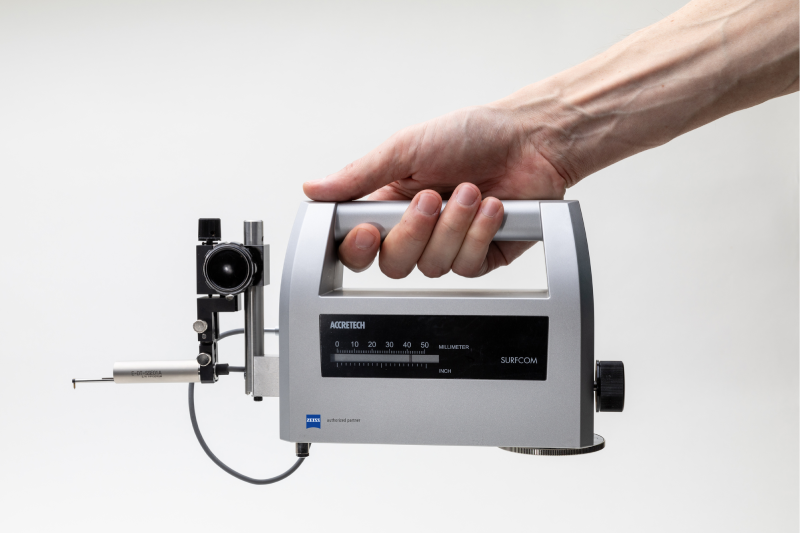
The way you measure Surface Roughness also affects which parameter you can choose. Traditional contact profilometers drag a stylus across the surface to create a profile. These work well for Ra or Rz but don’t give full surface maps.
Modern non-contact methods — like confocal microscopy or white-light interferometry — use light to scan the surface without touching it, producing detailed 3D maps that make Sa and other areal parameters more useful.
In advanced manufacturing environments, optical systems are rapidly becoming the standard because they-
- Don’t damage fragile materials.
- Capture larger areas quickly.
- Provide richer data for better decision-making.
Which Parameter Should You Choose? Quick Decision Guide
- Ra – When you need a basic, general estimate of surface quality.
- Rz – When surface extremes matter, especially for sealing or stress-bearing parts.
- Sa – When a full 3D understanding of surface texture impacts performance.
- Rq / Sq – When statistical or precise engineering analysis is required.
- Rt – When the largest deviation on a surface can cause failure.
Surface Roughness Isn’t One Size Fits All!
Choosing the right Surface Roughness parameter is more than just picking Ra because everyone else uses it. It’s about matching your manufacturing and performance needs with the best measurement tools and metrics available.
By understanding what Ra, Rz, Sa, and other parameters truly represent and how they affect your part’s function, you’ll make smarter decisions — reduce errors, cut costs, and build products that perform as expected in the real world.