


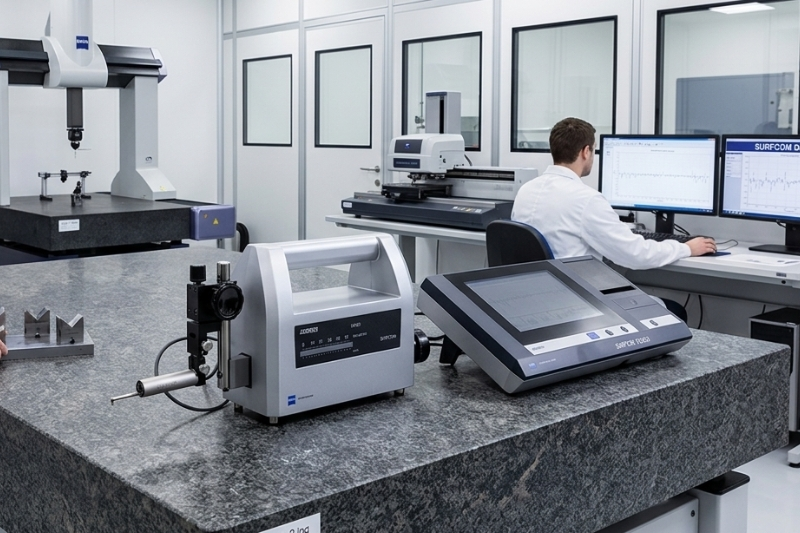
A tiny imperfection on a component’s surface can lead to product failure, rejected batches, unexpected downtime, or costly customer complaints. In industries like semiconductor manufacturing, electronics, automotive, and aerospace, surface quality isn’t just a specification—it’s a critical quality parameter.
That’s where a Surface Roughness Tester becomes essential. It helps manufacturers measure, verify, and maintain consistent surface finishes that directly impact performance, durability, and product reliability.
Whether you’re a quality control manager looking to reduce inspection errors or a production head planning to automate your inspection process, this guide explains everything you need to know about surface roughness testing, how it works, and how to choose the right solution for your manufacturing environment.
Table of Contents
- Why Surface Roughness Matters
- What is a Surface Roughness Tester?
- How Does Surface Roughness Measurement Work?
- Types of Surface Roughness Testers
- Portable vs. Bench-Type Surface Roughness Testers
- Understanding Ra, Rz, and Rq
- ISO Standards for Surface Roughness Testing
- Applications Across Industries
- How to Select the Right Surface Roughness Tester
- Common Surface Roughness Measurement Mistakes
- Frequently Asked Questions
- Conclusion
Why Does Surface Roughness Matter?
Every machined component may appear smooth to the naked eye, but microscopic peaks and valleys exist on every surface. These tiny irregularities influence:
- Product performance
- Wear resistance
- Friction
- Sealing capability
- Coating adhesion
- Fatigue life
- Corrosion resistance
In semiconductor and electronics manufacturing, even a slight deviation in surface finish can affect component assembly, electrical performance, and long-term reliability.
A reliable surface roughness test helps manufacturers detect these imperfections before products reach customers, reducing defects and improving production consistency.
What is a Surface Roughness Tester?
A Surface Roughness Tester is a precision metrology instrument used to measure the texture of a material’s surface. It evaluates microscopic surface irregularities and converts them into measurable values that help manufacturers verify whether a component meets design specifications.
Modern systems can measure parameters such as:
- Ra
- Rz
- Rq
- Rt
- Rmax
How Does Surface Roughness Measurement Work?
A surface roughness tester typically uses a highly sensitive stylus that moves across the surface of a component.
Here’s how the process works:
Step 1: Stylus Contact
The diamond-tipped probe gently travels across the workpiece.
Step 2: Profile Detection
The stylus records microscopic peaks and valleys.
Step 3: Digital Analysis
Software converts the collected profile into numerical roughness parameters.
Step 4: Inspection Report
The system generates an inspection report that can be compared against ISO standards and customer specifications.
Today’s advanced systems provide fast measurements, automatic data logging, and seamless integration with quality management software, significantly reducing manual inspection time.
What Are the Types of Surface Roughness Testers?
Choosing the right instrument depends on production volume, part size, and inspection requirements.
Portable Surface Roughness Tester
Best suited for:
- Shop floor inspections
- Large workpieces
- On-site quality checks
- Maintenance applications
Benefits:
- Lightweight
- Easy to operate
- Fast measurements
- Portable and flexible
Bench-Type Surface Roughness Tester
Ideal for:
- Laboratory environments
- High-precision inspection
- Semiconductor manufacturing
- Electronics production
- Medical device manufacturing
Benefits:
- Higher measurement accuracy
- Advanced analysis
- Greater repeatability
- Automated inspection capability
Portable vs. Bench-Type Surface Roughness Tester
Feature | Portable | Bench-Type |
Mobility | Excellent | Fixed |
Accuracy | Good | Very High |
Automation | Limited | Excellent |
Inspection Speed | Fast | Very Fast |
Ideal Use | Shop Floor | Quality Lab |
Best For | Maintenance | Precision Manufacturing |
Manufacturers focused on high-volume production often choose automated bench-type systems to improve consistency and reduce operator dependency.
What Are Ra, Rz, and Rq?
Understanding these surface roughness parameters is essential for selecting the right inspection criteria.
Ra (Average Roughness)
Ra is the arithmetic average of all surface deviations from the center line.
It is the most commonly specified surface finish parameter across manufacturing industries.
Rz (Average Maximum Height)
Rz measures the average height difference between the highest peaks and deepest valleys over multiple sampling lengths.
It provides a clearer picture of severe surface irregularities.
Rq (Root Mean Square Roughness)
Rq calculates the root mean square of profile deviations, making it more sensitive to larger surface variations than Ra.
It is commonly used in precision engineering and semiconductor applications.
Which ISO Standards Apply to Surface Roughness Testing?
To ensure consistent inspection worldwide, manufacturers follow internationally recognized standards.
Common standards include:
- ISO 4287
- ISO 4288
- ISO 21920
- ISO 3274
Following ISO standards helps manufacturers:
- Meet customer requirements
- Improve quality consistency
- Simplify audits
- Ensure global compliance
Which Industries Use Surface Roughness Testers?
Semiconductor & Electronics
Surface finish directly impacts:
- Wafer processing
- PCB manufacturing
- Connector reliability
- Precision assemblies
High-accuracy inspection minimizes microscopic defects and improves production yield.
Automotive Manufacturing
Surface roughness affects:
- Engine components
- Bearings
- Transmission parts
- Brake systems
Proper inspection improves wear resistance and component life.
Aerospace
Aircraft components require exceptionally tight tolerances.
Surface roughness testing ensures:
- Fatigue resistance
- Better aerodynamics
- Reliable sealing
- Safety compliance
Medical Devices
Medical implants and surgical instruments require highly controlled surface finishes to improve:
- Biocompatibility
- Sterility
- Performance
- Patient safety
Tool & Die Manufacturing
Precision cutting tools perform better when surface finishes remain within specification, improving machining quality and extending tool life.
How Do You Select the Right Surface Roughness Tester?
Choosing the right system involves more than comparing specifications.
Consider these factors:
Measurement Accuracy
Higher precision ensures reliable inspection results.
Automation Capability
Automated systems reduce inspection time and improve repeatability.
Software Integration
Look for systems that integrate with your quality management software and workflow.
Production Volume
High-volume manufacturing benefits from automated inspection solutions.
Standards Compliance
Ensure the equipment supports current ISO measurement standards.
Service & Support
Reliable technical support and calibration services reduce downtime and protect your investment.
Common Surface Roughness Measurement Mistakes
Even experienced manufacturers make avoidable mistakes.
Avoid these common issues:
- Using an incorrect cutoff length
- Measuring contaminated surfaces
- Skipping regular calibration
- Using worn stylus tips
- Ignoring environmental vibration
- Incorrect parameter selection (Ra vs. Rz)
- Poor operator training
Preventing these errors improves measurement consistency and reduces unnecessary product rejection.
Conclusion
As manufacturing tolerances become tighter in 2026, accurate surface inspection is no longer optional. A reliable Surface Roughness Tester helps manufacturers improve quality, reduce defects, maintain compliance, and build greater customer confidence.
For semiconductor, electronics, automotive, aerospace, and medical manufacturers, investing in advanced surface measurement technology means fewer production issues, higher process capability, and better long-term profitability.
Frequently Asked Questions (FAQs)
What is a surface roughness tester?
A surface roughness tester is a precision instrument used to measure microscopic surface irregularities and verify that manufactured components meet required surface finish specifications.
How does surface roughness affect product quality?
Surface roughness influences friction, wear resistance, sealing performance, coating adhesion, fatigue life, and overall product reliability. Poor surface finish can lead to premature component failure and increased manufacturing defects.
What is Ra?
Ra is the arithmetic average roughness value and is the most widely used parameter for evaluating surface finish in manufacturing.
What is Rz?
Rz measures the average height difference between the highest peaks and deepest valleys of a surface profile, making it useful for identifying significant surface irregularities.
Which industries use surface roughness testers?
Surface roughness testers are widely used in semiconductor manufacturing, electronics, automotive, aerospace, medical device production, precision machining, tool manufacturing, and metalworking industries.