


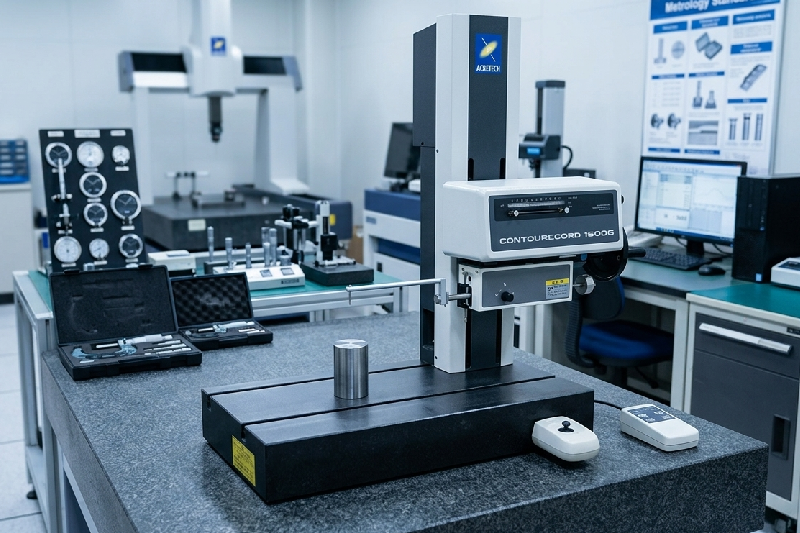
In precision engineering, even the smallest dimensional deviation can have significant consequences. A slight profile variation in a machined component can lead to assembly issues, product failures, customer complaints, costly rework, and production delays. As industries continue to demand tighter tolerances and higher quality standards, manufacturers are under constant pressure to improve measurement accuracy throughout the production process.
Traditional inspection methods often struggle to capture complex profiles and contours with the precision required for modern engineering applications. This is where a Contour Measurement Machine becomes an invaluable tool.
By providing highly accurate profile analysis and dimensional verification, contour measurement systems help manufacturers identify deviations early, reduce scrap, and ensure every component meets exact design specifications. In this article, we’ll explore how precision engineering companies can significantly improve part accuracy using advanced contour measurement technology.
Table of Contents
- Why Part Accuracy Matters in Precision Engineering
- What Is a Contour Measurement Machine?
- How Contour Measurement Systems Improve Part Accuracy
- Key Features to Look for in a Contour Measuring Instrument
- Applications in Precision Engineering and Machining
- Business Benefits of Investing in a Contour Measuring Machine
- Conclusion
- FAQs
Why Part Accuracy Matters in Precision Engineering?
Precision engineering companies manufacture components that often operate in demanding environments where accuracy is non-negotiable. Whether producing automotive parts, aerospace components, medical devices, molds, dies, or high-precision machined parts, dimensional consistency directly affects product performance.
A minor profile error can create multiple downstream challenges, including:
- Increased scrap and rework
- Assembly failures
- Reduced product lifespan
- Customer complaints
- Production delays
- Higher quality costs
For manufacturers working with micron-level tolerances, relying solely on conventional measurement methods is no longer enough. Advanced contour inspection has become a critical part of modern quality assurance strategies.
What Is a Contour Measurement Machine?
A Contour Measurement Machine is a high-precision metrology system designed to measure and analyze the profile, contour, and geometric characteristics of a component. Unlike basic dimensional measuring tools, contour measurement systems accurately evaluate complex shapes, curves, angles, radii, grooves, and surface transitions.
Often referred to as a Contour Machine, Contour Measuring Instrument, contour tracer, or contour tracer machine, these systems use precision probes and advanced software to compare actual part geometry against CAD models or engineering drawings.
The result is highly reliable data that helps quality teams verify whether manufactured components meet specified tolerances before they move further through production.
How Contour Measurement Systems Improve Part Accuracy
How Do Contour Measuring Machines Detect Deviations Early?
One of the biggest advantages of a contour measuring machine is its ability to identify profile deviations before they become larger production issues.
When manufacturers inspect parts during production rather than after completion, they can quickly detect:
- Tool wear
- Machine drift
- Incorrect machining parameters
- Material inconsistencies
- Setup errors
Early detection enables corrective action before hundreds or thousands of defective parts are produced.
How Does Contour Measurement Improve Tolerance Control?
Modern engineering drawings often include intricate contours and geometric tolerances that are difficult to verify using calipers, micrometers, or manual gauges.
A contour measuring system can accurately evaluate:
- Radius measurements
- Angles
- Heights
- Depths
- Distances
- Geometric profiles
- Form deviations
This detailed inspection capability ensures every manufactured component remains within specified tolerance limits.
How Does a Contour Tracer Improve Process Stability?
Manufacturing consistency depends heavily on process stability. Without accurate measurement feedback, small process variations can gradually impact product quality.
A contour tracer provides detailed measurement data that helps manufacturers:
- Monitor process capability
- Track production trends
- Identify recurring quality issues
- Optimize machining parameters
- Improve repeatability
Over time, this data-driven approach significantly enhances manufacturing consistency and overall product quality.
What Features Should You Look for in a Contour Measuring Instrument?
Not all contour measurement systems offer the same capabilities. When evaluating a solution, quality managers should focus on features that directly impact measurement accuracy and operational efficiency.
High Measurement Accuracy
The primary purpose of a contour measurement system is to deliver precise results. Look for systems capable of measuring complex geometries with exceptional repeatability and minimal measurement uncertainty.
Advanced Analysis Software
Modern contour machines provide powerful software for:
- CAD comparison
- Profile evaluation
- Automated reporting
- Tolerance analysis
- Statistical quality control
These features help quality teams make faster and more informed decisions.
Automation Capabilities
Automated measurement routines reduce operator dependency and improve inspection consistency across shifts and production batches.
Flexible Measurement Range
A versatile system should accommodate a wide variety of component sizes and geometries commonly found in precision machining environments.
Industry-Proven Reliability
Manufacturers often choose globally trusted solutions such as the ZEISS Contour Measuring Machine because of their proven accuracy, advanced software integration, and long-term reliability in demanding industrial applications.
Applications of Contour Measurement in Precision Engineering
Contour measurement technology supports a broad range of precision engineering applications.
CNC Machined Components
Verify profiles, grooves, threads, radii, and complex contours with exceptional accuracy.
Automotive Manufacturing
Inspect engine components, transmission parts, fuel system components, and safety-critical assemblies.
Aerospace Components
Ensure compliance with stringent dimensional requirements and regulatory standards.
Tool and Die Manufacturing
Validate mold cavities, cutting tool profiles, and precision die geometries.
Medical Device Production
Maintain strict dimensional control for implants, surgical instruments, and precision medical components.
In each of these applications, accurate contour inspection directly contributes to higher product quality and lower manufacturing risk.
What Are the Business Benefits of Investing in a Contour Measuring Machine?
While accuracy remains the primary objective, the business impact extends far beyond measurement itself.
Reduced Scrap and Rework
Detecting deviations early prevents defective products from progressing through production.
Improved Customer Satisfaction
Consistently accurate components lead to fewer complaints and stronger customer relationships.
Faster Root Cause Analysis
Detailed contour data helps quality teams identify and resolve manufacturing issues more quickly.
Increased Production Efficiency
Automated inspection reduces manual measurement time and improves throughput.
Stronger Competitive Advantage
Manufacturers that consistently deliver high-quality parts gain greater trust from customers and secure more long-term contracts.
According to industry best practices, companies that implement advanced metrology solutions often experience measurable improvements in process capability, quality performance, and operational profitability.
Conclusion
In today’s precision engineering environment, achieving exceptional part accuracy requires more than skilled machining. It requires accurate, repeatable, and data-driven measurement systems capable of validating increasingly complex geometries.
A modern Contour Measurement Machine provides manufacturers with the tools needed to improve dimensional accuracy, strengthen quality control, reduce production costs, and meet demanding customer specifications. Whether you’re producing automotive components, aerospace parts, medical devices, or high-precision machined products, contour measurement technology can play a critical role in your quality assurance strategy.
As tolerances become tighter and customer expectations continue to rise, investing in advanced contour inspection is no longer simply a quality improvement initiative—it’s a competitive necessity.
Frequently Asked Questions (FAQs)
What is a Contour Measurement Machine?
A Contour Measurement Machine is a precision metrology system used to measure profiles, contours, radii, angles, grooves, and geometric features of manufactured components.
What industries use contour measuring machines?
Industries including automotive, aerospace, medical device manufacturing, tool and die production, and precision machining commonly use contour measurement systems.
How does a contour tracer machine improve product quality?
A contour tracer machine detects profile deviations, verifies dimensional accuracy, and helps manufacturers maintain tight tolerances throughout production.
What is the difference between a contour machine and traditional measuring tools?
Traditional measuring tools typically capture basic dimensions, while contour machines analyze complex profiles and geometric characteristics with significantly higher accuracy.
Why do precision engineering companies invest in contour measuring instruments?
They invest in contour measuring instruments to improve quality control, reduce scrap, increase process stability, ensure compliance with specifications, and enhance customer satisfaction.