


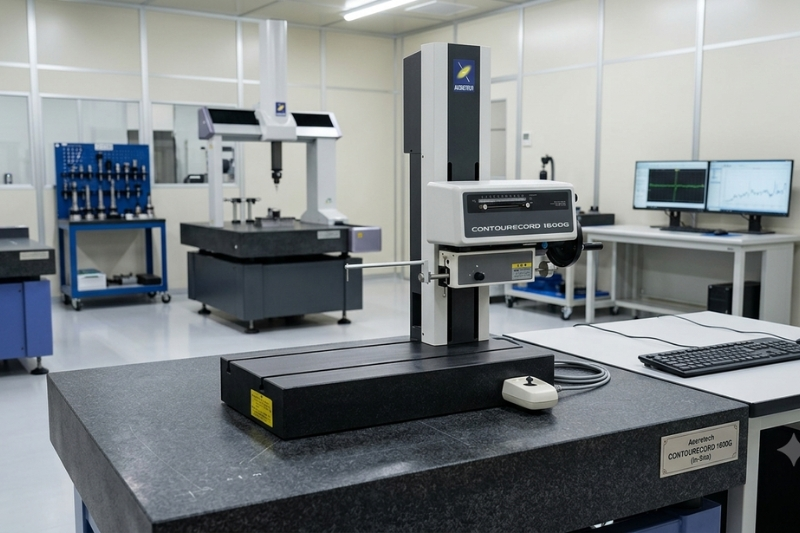
Looking for the Right Contour Measuring Machine? Here's What You Need to Know
Choosing the right contour measuring machine isn’t just about buying another piece of inspection equipment—it’s about investing in product quality, manufacturing efficiency, and customer confidence.
Imagine spending hours machining a precision component only to discover it fails quality inspection because of an unnoticed contour deviation. The result? Production delays, material waste, unhappy customers, and increased costs.
That’s exactly why manufacturers across automotive, electronics, aerospace, medical, and precision engineering industries rely on advanced contour measurement systems.
This buying guide explains everything you need to know—from how a contour measuring machine works to the features that truly matter—so you can confidently choose a system that matches your inspection requirements.
Table of Contents
- What is a Contour Measuring Machine?
- How Does a Contour Measuring Machine Work?
- Industries That Use Contour Measurement
- 2D vs 3D Contour Measurement
- Contour Measurement vs Profile Measurement
- Key Features to Look For
- How to Choose the Right Contour Measuring Machine
- Understanding ROI Before Buying
- Frequently Asked Questions
- Conclusion
What is a Contour Measuring Machine?
A contour measuring machine is a precision inspection system designed to measure the shape, geometry, angles, radii, grooves, edges, and contours of manufactured components with extremely high accuracy.
Also known as a Contour Measurement Machine or Contour Measuring Instrument, it captures the exact profile of a workpiece using a precision stylus that traces its surface. The collected data is then analyzed through specialized software to compare the actual dimensions with design specifications.
In simple terms, it helps manufacturers answer one important question:
“Does this part match the engineering drawing?”
That answer can make the difference between delivering a perfect product or an expensive rejection.
How Does a Contour Measuring Machine Work?
The working principle is surprisingly straightforward.
Step 1: Position the Component
The workpiece is securely placed on the measuring table.
Step 2: Stylus Scanning
A highly sensitive probe moves across the component’s surface, recording every contour, edge, groove, radius, and angle.
Step 3: Data Collection
Thousands of measurement points are captured within seconds.
Step 4: Software Analysis
Advanced software converts the measured data into a detailed contour profile, compares it against CAD drawings or tolerances, and instantly generates inspection reports.
This process minimizes operator error while significantly improving inspection consistency.
What Industries Use Contour Measuring Machines?
Contour inspection has become essential wherever dimensional accuracy directly impacts product performance.
Automotive Industry
Automotive manufacturers inspect:
- Engine components
- Transmission parts
- Camshafts
- Pistons
- Brake systems
- Gear profiles
Accurate contour measurement ensures better assembly and longer product life.
Bearings Industry
Bearing manufacturers use contour measuring instruments to verify:
- Raceway profiles
- Groove geometry
- Radius measurements
- Surface transitions
Even microscopic contour errors can reduce bearing lifespan.
Medical Components
Medical devices demand extremely tight tolerances.
Contour measuring systems inspect:
- Surgical tools
- Dental implants
- Orthopedic implants
- Precision medical components
Consistent measurement helps manufacturers meet strict regulatory standards.
Plastic Parts Manufacturing
Injection molded parts often require contour verification for:
- Snap fits
- Sealing surfaces
- Mold geometry
- Functional edges
Contour inspection helps reduce assembly issues before products reach customers.
Optical Components
Manufacturers producing optical assemblies use contour measurement to inspect:
- Lens holders
- Precision housings
- Alignment features
- Mechanical interfaces
Accurate contour data improves overall optical performance.
2D vs 3D Contour Measurement: Which One Should You Choose?
Choosing between 2D and 3D inspection depends entirely on your application.
2D Contour Measurement
Best for:
- Cross-sectional profiles
- Grooves
- Angles
- Radii
- Simple geometries
Advantages:
- Faster inspections
- Lower investment
- Easier programming
- High repeatability
3D Contour Measurement
Ideal for:
- Complex geometries
- Freeform surfaces
- Multi-axis components
- Advanced engineering parts
Advantages:
- Complete dimensional analysis
- Better visualization
- Suitable for highly complex products
If your production mainly involves standard machined components, a high-quality 2D contour measuring machine often delivers excellent value.
Contour Measurement vs Profile Measurement
These terms are often used interchangeably, but they serve different purposes.
Contour Measurement | Profile Measurement |
Measures complete geometry | Measures surface texture or line profile |
Evaluates angles, radii, grooves | Evaluates surface characteristics |
Used for dimensional inspection | Used for finish evaluation |
Focuses on shape accuracy | Focuses on surface quality |
Many modern systems combine both capabilities, allowing manufacturers to perform multiple inspections using a single machine.
What Features Should You Look for in a Contour Measuring Machine?
Not every machine offers the same capabilities. Before making your investment, evaluate these critical features.
1. Measurement Accuracy
High accuracy is the foundation of reliable inspection.
Look for systems that offer:
- High-resolution sensors
- Excellent repeatability
- Stable mechanical construction
- Certified calibration standards
The more accurate the machine, the fewer quality issues you’ll encounter.
2. Intelligent Software
Powerful software simplifies inspection.
Choose software that provides:
- CAD comparison
- Automatic measurement programs
- Easy report generation
- Statistical analysis
- Data export options
- User-friendly interface
Good software saves operators valuable inspection time.
3. Automation Capabilities
As production grows, manual inspection becomes a bottleneck.
Modern contour measuring machines support:
- CNC automation
- Automatic measurement routines
- Batch inspections
- Reduced operator dependency
Automation increases productivity while improving consistency.
4. Measurement Speed
Inspection should never slow production.
A faster contour measuring instrument allows manufacturers to:
- Inspect more components
- Reduce downtime
- Improve production flow
- Increase throughput
Speed becomes especially valuable in high-volume manufacturing.
How to Choose the Right Contour Measuring Machine
Before purchasing, ask yourself these practical questions.
What components will you inspect?
Large components require longer measuring ranges, while miniature parts demand higher precision.
What level of accuracy do you need?
Industries like aerospace and medical manufacturing require tighter tolerances than general machining.
Will your inspection needs grow?
Buying a scalable system today can eliminate expensive upgrades tomorrow.
Is the software easy to use?
Complex software increases training time and slows inspections.
Does the supplier provide support?
Reliable installation, training, calibration, and after-sales service are just as important as machine specifications.
Choosing the right partner often matters as much as choosing the right machine.
Is a Contour Measuring Machine Worth the Investment?
Absolutely.
While the initial investment may seem significant, the long-term returns are substantial.
A quality contour measuring machine helps manufacturers:
- Reduce product rejection
- Improve first-pass quality
- Minimize material waste
- Lower rework costs
- Increase production efficiency
- Build customer trust
- Meet international quality standards
For many manufacturers, the machine pays for itself through improved productivity and reduced quality-related losses.
Conclusion
Precision manufacturing leaves no room for guesswork.
Whether you’re producing automotive parts, medical devices, bearings, optical assemblies, or plastic components, investing in the right contour measuring machine ensures every product meets exact design specifications.
Instead of focusing only on price, evaluate accuracy, software capabilities, automation, measurement speed, scalability, and supplier support. The right Contour Measurement Machine becomes more than an inspection tool—it becomes a long-term asset that improves quality, efficiency, and profitability.
Choosing wisely today can help your business stay competitive for years to come.
Frequently Asked Questions (FAQs)
What is a contour measuring machine?
A contour measuring machine is a precision inspection system that measures the shape, geometry, radii, angles, grooves, and contours of manufactured components to verify dimensional accuracy.
How accurate is contour measurement?
Modern contour measuring instruments can achieve micron-level accuracy, making them suitable for industries requiring extremely tight tolerances, including automotive, aerospace, electronics, and medical manufacturing.
What industries need contour inspection?
Contour inspection is widely used in:
- Automotive
- Bearings
- Medical device manufacturing
- Precision machining
- Plastic molding
- Electronics
- Aerospace
- Optical component manufacturing
What is profile measurement?
Profile measurement evaluates the surface profile or finish of a component, while contour measurement focuses on its overall geometry and dimensional accuracy. Many advanced systems support both inspection methods.