


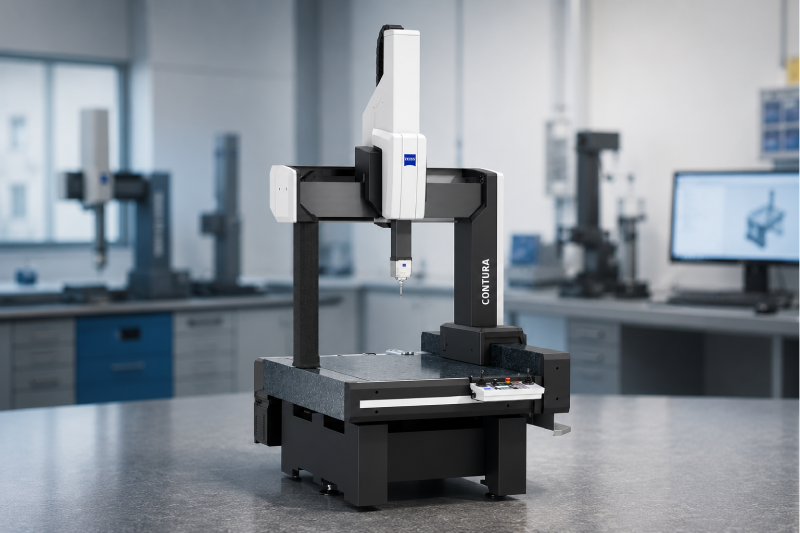
When precision determines product quality, even the smallest measurement error can lead to rejected parts, production delays, and increased manufacturing costs. Whether you’re producing automotive components, aerospace parts, medical devices, or precision molds, maintaining dimensional accuracy isn’t optional—it’s essential.
That’s where a coordinate measuring machine comes into play. Instead of relying on manual inspection methods that are time-consuming and prone to human error, manufacturers use CMMs to verify dimensions with exceptional precision and consistency.
In this guide, you’ll learn everything about the coordinate measuring machine, including how it works, different types of CMMs, their applications across industries, key benefits, buying considerations, and maintenance tips. If you’re planning to invest in a CMM machine, this guide will help you make an informed decision.
Table of Contents
- What is a Coordinate Measuring Machine?
- How Does a Coordinate Measuring Machine Work?
- Types of Coordinate Measuring Machines
- What is CMM Inspection?
- Industries That Use CMM Machines
- Benefits of Using a Coordinate Measuring Machine
- How to Choose the Right CMM Machine
- Maintenance Tips
- Future Trends in Coordinate Measurement
- Frequently Asked Questions
- Conclusion
- Meta Description
- Call-to-Action
What is a Coordinate Measuring Machine?
A coordinate measuring machine (CMM) is a precision inspection system used to measure the physical geometry of manufactured components. It accurately captures the X, Y, and Z coordinates of a part to verify whether it meets design specifications.
A CMM coordinate measuring machine uses touch probes or non-contact laser scanners to inspect dimensions, profiles, hole positions, angles, flatness, roundness, and geometric tolerances with micron-level accuracy.
Unlike traditional measuring tools such as calipers or micrometers, a CMM provides automated, repeatable, and highly accurate measurements, making it a critical part of modern quality control.
How Does a Coordinate Measuring Machine Work?
A coordinate measuring machine operates by moving a probe or scanning sensor across a workpiece. The machine records thousands of coordinate points and compares them with the original CAD model or engineering drawing.
The inspection process typically includes:
- Positioning the component securely.
- Creating or importing the inspection program.
- Probing or scanning the surface.
- Collecting measurement data.
- Comparing actual dimensions with CAD specifications.
- Generating an inspection report.
This automated workflow minimizes inspection errors while improving productivity and traceability.
What Are the Types of Coordinate Measuring Machines?
Choosing the right CMM machine depends on the size of your components, inspection speed, required accuracy, and production environment.
1. Bridge Coordinate Measuring Machine
Bridge CMMs are the most commonly used systems in precision manufacturing.
Best For
- Automotive components
- Precision machining
- Electronics
- General manufacturing
Advantages
- Excellent accuracy
- Stable structure
- Ideal for medium-sized components
2. Horizontal Arm CMM
Horizontal arm CMMs are designed for inspecting large and bulky workpieces.
Common Applications
- Automotive body panels
- Aircraft structures
- Heavy machinery
Advantages
- Easy loading
- Large measuring range
- Suitable for oversized parts
3. Cantilever CMM
Cantilever CMMs provide easy access to the measuring area from three sides.
Ideal For
- Small precision parts
- Tool rooms
- Laboratories
Benefits
- Compact design
- Fast measurement
- Excellent accessibility
4. Portable Coordinate Measuring Machine
Portable CMMs allow inspection directly on the production floor.
These systems eliminate the need to transport heavy components to a dedicated inspection room.
Best For
- Large assemblies
- On-site inspection
- Reverse engineering
5. Articulated Arm CMM
An articulated arm CMM combines portability with flexibility.
The operator manually moves the arm while the machine records accurate coordinate data.
Advantages
- Easy to operate
- Portable
- Flexible measurement angles
6. Laser Scanner CMM
Modern coordinate measuring machines increasingly integrate laser scanning technology.
Instead of touching the surface, laser scanners rapidly collect millions of measurement points.
Advantages
- Extremely fast inspection
- High-density point cloud
- Suitable for complex surfaces
- Excellent for reverse engineering
What is CMM Software?
The hardware is only one part of a modern inspection system.
Advanced CMM software controls measurement routines, analyzes collected data, compares results with CAD models, and generates detailed inspection reports.
Popular software capabilities include:
- CAD comparison
- GD&T evaluation
- SPC analysis
- Automated reporting
- Reverse engineering support
- Digital inspection workflows
Powerful software significantly improves inspection speed while reducing manual programming time.
What is CMM Inspection?
CMM inspection is the process of verifying manufactured parts using a coordinate measuring machine to ensure they meet engineering specifications.
During inspection, the machine checks:
- Dimensions
- Hole locations
- Flatness
- Perpendicularity
- Circularity
- Surface profiles
- Position tolerances
- Geometric tolerances
This ensures every component satisfies quality standards before reaching customers.
Which Industries Use Coordinate Measuring Machines?
Automotive Industry
Automotive manufacturers rely on CMMs to inspect engine blocks, gears, transmission parts, chassis components, and body panels.
Benefits include:
- Improved assembly accuracy
- Lower rejection rates
- Consistent product quality
Aerospace Industry
Aircraft components require extremely tight tolerances.
Coordinate measuring machines help inspect:
- Turbine blades
- Engine components
- Landing gear
- Structural assemblies
Even microscopic deviations can impact safety, making precision inspection essential.
Medical Industry
Medical device manufacturers use CMMs to inspect implants, surgical instruments, orthopedic components, and precision medical equipment.
High accuracy ensures compliance with stringent regulatory standards.
Energy Industry
Power generation industries inspect turbines, valves, pumps, and precision-machined parts using CMM technology to improve reliability and operational efficiency.
Die & Mold Industry
Toolmakers use coordinate measuring machines to validate molds and dies before production.
Accurate inspection minimizes costly rework and improves mold life
What Are the Benefits of Using a Coordinate Measuring Machine?
Investing in a coordinate measuring machine offers several advantages:
- Exceptional measurement accuracy
- Faster inspection cycles
- Reduced human error
- Automated quality control
- Improved production efficiency
- Better product consistency
- Reduced scrap and rework
- Complete digital inspection reports
- Increased customer confidence
- Long-term cost savings
Modern manufacturers view a CMM not as an expense but as an investment in quality assurance.
How to Choose the Right Coordinate Measuring Machine
Selecting the right system depends on your manufacturing requirements.
Consider the following factors:
Component Size
Choose a measuring volume suitable for your largest parts.
Required Accuracy
Higher precision applications require machines with tighter tolerances.
Measurement Speed
High-volume production often benefits from automated scanning systems.
Probe Technology
Select between touch probes, optical sensors, or laser scanners based on application.
Software Compatibility
Ensure compatibility with CAD files and reporting requirements.
Automation Needs
Consider robotic loading and automated inspection if production volume is high.
After-Sales Support
Reliable calibration, training, and service support are equally important.
Maintenance Tips for CMM Machines
Proper maintenance extends machine life and ensures consistent accuracy.
Follow these best practices:
- Keep the machine clean and dust-free.
- Maintain stable room temperature.
- Perform regular calibration.
- Inspect probes periodically.
- Update software regularly.
- Train operators properly.
- Follow preventive maintenance schedules.
Routine maintenance minimizes downtime and preserves measurement accuracy.
Future Trends in Coordinate Measurement
Coordinate measurement technology continues to evolve rapidly.
Emerging trends include:
- AI-assisted inspection
- Smart factory integration
- Industry 4.0 connectivity
- Automated robotic inspection
- Digital twins
- Cloud-based quality management
- High-speed optical scanning
- Predictive maintenance
These innovations are making inspection faster, smarter, and more efficient than ever before.
Conclusion
Precision manufacturing demands precision inspection. A coordinate measuring machine provides manufacturers with the accuracy, repeatability, and confidence needed to produce high-quality components while reducing waste and improving efficiency.
Whether you’re inspecting automotive parts, aerospace components, medical devices, or precision molds, investing in the right CMM machine can significantly improve quality control and productivity. By understanding the different machine types, inspection methods, software capabilities, and buying considerations, you can select a solution that aligns with your manufacturing goals and future growth.
Frequently Asked Questions (FAQs)
What is CMM?
A Coordinate Measuring Machine (CMM) is a precision inspection system that measures the physical dimensions and geometry of manufactured components using coordinate points.
How does a coordinate measuring machine work?
A CMM uses touch probes or laser scanners to collect measurement points on a part and compares them with CAD models or engineering drawings to verify dimensional accuracy.
What are the types of CMM?
The main types include Bridge CMM, Horizontal Arm CMM, Cantilever CMM, Portable CMM, Articulated Arm CMM, and Laser Scanner CMM.
How accurate is a CMM?
Modern coordinate measuring machines can achieve accuracy within a few microns, depending on the machine configuration and application.
What is CMM inspection?
CMM inspection is the process of measuring manufactured parts using a coordinate measuring machine to verify dimensions, geometric tolerances, and compliance with design specifications.