


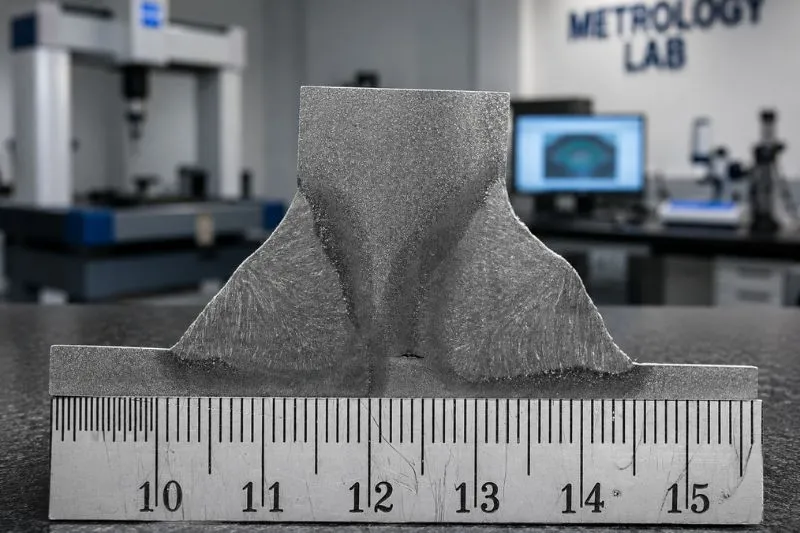
Heavy fabrication projects leave no room for weak welds. Whether you’re manufacturing structural steel, pressure vessels, mining equipment, cranes, or heavy machinery, the strength of every weld directly impacts safety, durability, and long-term performance.
This is where weld penetration becomes one of the most critical factors in welding quality. Even a visually perfect weld can fail if the penetration isn’t deep enough to create a strong bond between the base metals. Unfortunately, poor welding penetration often goes unnoticed until costly repairs, production delays, or even catastrophic failures occur.
In this blog, you’ll learn why weld penetration is essential, how it affects heavy fabrication projects, the role of weld inspection, and how advanced inspection technologies help manufacturers achieve reliable penetration welding every time.
Table of Contents
- What Is Weld Penetration?
- Why Does Weld Penetration Matter in Heavy Fabrication?
- How Does Poor Weld Penetration Affect Product Quality?
- What Causes Inadequate Welding Penetration?
- How Can Weld Inspection Detect Penetration Defects?
- Which Inspection Methods Are Best for Heavy Fabrication?
- Best Practices for Achieving Consistent Penetration Welding
- Conclusion
- FAQs
What Is Weld Penetration?
Weld penetration refers to the depth at which molten weld metal fuses into the base material during welding. Simply put, it measures how well the weld joins two pieces of metal below the surface.
The deeper and more consistent the penetration, the stronger the weld joint becomes.
In heavy fabrication, proper penetration ensures that welded structures can safely withstand:
- Heavy mechanical loads
- Dynamic stress
- Extreme temperatures
- Continuous vibration
- Harsh industrial environments
Without adequate penetration, even a weld that looks flawless on the surface may contain hidden weaknesses that compromise structural integrity.
Why Is Weld Penetration So Important in Heavy Fabrication?
Heavy fabrication involves components that often operate under extreme working conditions. A single weak weld can lead to expensive downtime or serious safety hazards.
Proper welding penetration offers several advantages:
Stronger Structural Integrity
Deep penetration creates complete fusion between materials, allowing fabricated components to handle heavy operational loads.
Improved Safety
Industries such as construction, mining, shipbuilding, oil & gas, and power generation depend on weld quality to protect workers and equipment.
Longer Equipment Life
Proper penetration reduces fatigue cracks and extends the service life of fabricated structures.
Lower Repair Costs
Quality welds reduce rework, warranty claims, and unexpected maintenance expenses.
Better Compliance
Many fabrication projects require compliance with AWS, ISO, ASME, or customer-specific quality standards where weld quality is mandatory.
How Does Poor Welding Penetration Affect Product Quality?
Insufficient welding penetration creates hidden internal defects that may not be visible during routine visual inspection.
Common problems include:
- Lack of fusion
- Incomplete joint penetration
- Internal voids
- Crack initiation
- Premature weld failure
- Reduced load-bearing capacity
For heavy fabrication manufacturers, these defects can result in:
- Project delays
- Product recalls
- Customer complaints
- Failed quality audits
- Increased production costs
- Safety risks
This is why experienced fabrication companies invest heavily in accurate weld inspection methods.
What Causes Poor Weld Penetration?
Several welding variables influence penetration quality.
The most common causes include:
Incorrect Welding Current
Low amperage often prevents sufficient fusion.
Improper Travel Speed
Moving too quickly limits heat input and reduces penetration depth.
Poor Joint Preparation
Incorrect bevel angles or contaminated surfaces restrict weld fusion.
Incorrect Electrode Selection
Using unsuitable electrodes or filler materials affects penetration consistency.
Inconsistent Welding Technique
Operator skill plays a significant role in achieving repeatable results.
Understanding these factors helps manufacturers minimize defects before production issues arise.
How Can Weld Inspection Detect Penetration Problems?
One of the biggest challenges with penetration defects is that they’re usually hidden beneath the weld surface.
Modern weld inspection techniques allow quality teams to detect internal discontinuities before products leave the factory.
Inspection methods commonly used include:
Visual Inspection (VT)
Ideal for identifying surface-level imperfections but cannot detect internal penetration defects.
Ultrasonic Testing (UT)
Uses high-frequency sound waves to identify internal flaws without damaging the component.
Best suited for:
- Thick steel plates
- Structural fabrication
- Pressure vessels
Radiographic Testing (RT)
X-ray imaging reveals hidden weld discontinuities and penetration defects.
Ideal for:
- Critical weld joints
- High-pressure applications
- Certified fabrication projects
Phased Array Ultrasonic Testing (PAUT)
PAUT provides highly detailed imaging of weld quality and offers faster inspection compared to conventional ultrasonic testing.
Many heavy fabrication companies now prefer PAUT because it delivers accurate defect characterization while reducing inspection time.
What Are the Benefits of Consistent Penetration Welding?
Consistent penetration welding delivers measurable improvements across production.
These include:
- Higher first-pass acceptance rates
- Reduced weld repairs
- Faster project completion
- Improved customer confidence
- Lower inspection costs
- Better long-term reliability
- Increased workplace safety
For manufacturers competing in today’s demanding industrial environment, these advantages directly contribute to profitability.
How Can Heavy Fabrication Companies Improve Weld Penetration?
Improving weld quality requires more than experienced welders.
Successful manufacturers combine skilled personnel with standardized processes and advanced inspection equipment.
Best practices include:
Use Qualified Welding Procedures
Develop and validate Welding Procedure Specifications (WPS) for every application.
Train Welding Operators
Regular certification and skill development improve consistency.
Optimize Welding Parameters
Monitor voltage, current, travel speed, and heat input carefully.
Prepare Materials Correctly
Proper edge preparation significantly improves penetration quality.
Perform Regular Weld Inspection
Early defect detection prevents expensive downstream failures.
Invest in Advanced Inspection Technology
Modern non-destructive testing (NDT) systems improve inspection accuracy while reducing production delays.
Why Should Manufacturers Invest in Advanced Weld Inspection Equipment?
As fabrication projects become larger and more complex, manual inspection methods alone are no longer sufficient.
Advanced inspection solutions help manufacturers:
- Detect hidden penetration defects early
- Reduce inspection time
- Improve production efficiency
- Maintain international quality standards
- Reduce warranty costs
- Deliver consistent product quality
For companies working in heavy fabrication, investing in reliable inspection equipment isn’t just a quality improvement—it’s a competitive advantage.
Conclusion
In heavy fabrication, every weld plays a critical role in the overall strength and safety of the final product. Proper weld penetration ensures that welded joints can withstand demanding operating conditions while reducing the risk of costly failures.
By combining optimized welding procedures, skilled operators, and advanced weld inspection technologies, manufacturers can consistently achieve superior welding penetration and dependable penetration welding quality.
Ultimately, stronger welds lead to safer structures, lower maintenance costs, greater customer confidence, and improved business performance.
Frequently Asked Questions (FAQs)
What is weld penetration?
Weld penetration is the depth to which the weld metal fuses into the base material, creating a strong and durable joint.
Why is weld penetration important?
Proper weld penetration improves joint strength, increases structural reliability, enhances safety, and reduces the likelihood of weld failure.
How is weld penetration inspected?
Manufacturers commonly use visual inspection, ultrasonic testing (UT), radiographic testing (RT), and phased array ultrasonic testing (PAUT) to evaluate weld quality.
What causes poor welding penetration?
Common causes include incorrect welding current, excessive travel speed, poor joint preparation, improper electrode selection, and inconsistent welding techniques.
Which industries require accurate weld inspection?
Heavy fabrication, shipbuilding, construction, mining, oil & gas, power generation, automotive, aerospace, and pressure vessel manufacturing all rely on accurate weld inspection.