


Table of Contents
- What Is PMI and Why Is It Important in Oil & Gas Pipelines?
- Why Are Material Mix-Ups a Major Risk in Pipeline Fabrication?
- How Do XRF Analyzers Help Verify Pipeline Materials?
- Why Are Handheld XRF Analyzers Suitable for On-Site PMI?
- What Problems Can Traditional Material Verification Methods Create?
- How Does a Handheld XRF Machine Work for Pipeline PMI?
- Which Pipeline Materials Can Portable XRF Analyzers Help Identify?
- How Do Portable XRF Analyzers Improve Incoming Material Inspection?
- How Can Handheld XRF Analyzers Support Weld and Component Traceability?
- How Can Portable XRF Spectrometers Reduce Rework and Production Delays?
- What Should Oil & Gas Companies Consider When Selecting XRF Analyzers?
- How Can QS Metrology Support Oil & Gas Material Verification?
- Conclusion
- FAQs
What Is PMI and Why Is It Important in Oil & Gas Pipelines?
Positive Material Identification (PMI) is the process of verifying the elemental composition of a material to confirm that it matches the specified alloy or material grade.
In oil & gas pipeline fabrication, PMI can be an important quality-control activity because components may be manufactured from different grades of stainless steel, carbon steel, low-alloy steel, nickel alloys, and other engineering materials.
Two metal components can look almost identical while having significantly different chemical compositions.
So, how can a fabrication team confirm that the correct material has been used?
This is where XRF analyzers can provide rapid elemental analysis directly at the inspection location.
Portable and handheld XRF technology enables technicians to analyze materials on-site without sending every component to a laboratory. QS Metrology describes its portable XRF analyzers as fast, non-destructive instruments for elemental composition analysis across metals, alloys, mining, metallurgy, and environmental applications.
Why Are Material Mix-Ups a Major Risk in Pipeline Fabrication?
How Can the Wrong Alloy Affect Pipeline Quality?
Oil & gas fabrication projects may involve large quantities of pipes, fittings, flanges, valves, plates, weld components, and other metallic parts.
When different alloy grades are stored, processed, or transported within the same facility, material identification becomes an important quality-control challenge.
A material mix-up can happen because of:
- Similar visual appearance between alloy grades
- Incorrect material marking
- Supplier or batch errors
- Poor segregation of materials
- Incorrect component identification
- Loss of traceability during fabrication
- Manual documentation errors
The problem becomes more serious when an incorrect material progresses through cutting, machining, welding, assembly, coating, or installation.
By the time the error is discovered, significant time and money may already have been invested.
Why Is Early Material Verification Important?
The earlier a material mismatch is detected, the easier it is to correct.
A handheld XRF machine can allow inspection teams to perform rapid material verification at receiving areas, warehouses, fabrication shops, or project sites.
Instead of relying solely on paperwork or visual identification, technicians can obtain elemental information directly from the material.
How Do XRF Analyzers Help Verify Pipeline Materials?
What Does an XRF Analyzer Actually Measure?
XRF stands for X-ray fluorescence.
An XRF analyzer exposes the material to X-rays, causing atoms in the material to emit characteristic secondary X-rays. The instrument detects these signals and uses them to determine the elements present and their concentrations.
In practical terms, this means an operator can use an XRF analyzer to obtain information about the elemental composition of a metal or alloy.
For oil & gas applications, this can support activities such as:
- Alloy identification
- PMI
- Incoming material verification
- Material sorting
- Supplier verification
- Component identification
- Quality control
- Failure investigation
QS Metrology states that its portable XRF analyzers provide near-instantaneous results, non-destructive testing, portability, and ease of operation.
Why Are Handheld XRF Analyzers Suitable for On-Site PMI?
Traditional laboratory analysis can provide highly detailed results, but sending every component or sample to a laboratory is not always practical for production environments.
So, what makes handheld XRF analyzers useful for PMI?
Can Handheld XRF Analyzers Be Used Directly on Components?
Yes. Their compact design allows technicians to bring the analyzer to the component rather than transporting the component to a laboratory.
This is particularly useful when inspecting:
- Large-diameter pipes
- Flanges
- Valves
- Fittings
- Structural components
- Fabricated assemblies
- Installed or difficult-to-move components
How Quickly Can Material Verification Be Performed?
Portable XRF systems are designed for rapid analysis, allowing inspection teams to make material-identification decisions without waiting for conventional laboratory turnaround.
QS Metrology describes its portable XRF systems as delivering results from turn-on and trigger pull to near-instantaneous analysis.
Are Handheld XRF Analyzers Non-Destructive?
Yes. XRF is a non-destructive analytical technique, making it suitable when the component must remain usable after inspection.
This can be particularly valuable for expensive pipeline components and fabricated assemblies.
What Problems Can Traditional Material Verification Methods Create?
Why Can Visual Material Identification Be Unreliable?
Visual inspection cannot reliably distinguish every alloy grade.
Surface appearance, colour, markings, and component geometry can provide useful information, but they do not directly establish elemental composition.
Why Can Laboratory Testing Slow Down Production?
Laboratory analysis can introduce:
- Sample transportation
- Sample preparation
- Laboratory scheduling
- Testing queues
- Result turnaround time
- Additional handling
For large fabrication projects, these delays can affect production schedules.
How Can Portable XRF Analyzers Change the Workflow?
Instead of moving every questionable component through a laboratory workflow, inspection teams can perform rapid screening and verification at the point where the material is received, stored, fabricated, or inspected.
This creates a simpler workflow:
Receive → Scan → Identify → Verify → Record → Release
The result is faster decision-making without sacrificing the benefit of elemental analysis.
How Does a Handheld XRF Machine Work for Pipeline PMI?
The process is relatively straightforward.
How Is the Pipeline Component Prepared?
The inspection area should be suitable for XRF measurement and prepared according to the instrument’s operating procedure.
Surface condition can affect analytical performance, so appropriate surface preparation and measurement practices remain important.
How Does the Handheld XRF Machine Analyze the Material?
The instrument directs X-rays toward the material surface.
The material emits characteristic fluorescent X-rays, which are detected by the analyzer.
The instrument’s software processes these signals and provides elemental information.
How Does the Inspector Confirm the Material Grade?
The measured elemental composition can be compared with the applicable material specification or grade library used by the inspection team.
This helps determine whether the tested component corresponds to the expected alloy.
How Can the Result Be Documented?
Depending on the analyzer and software configuration, results can be transferred, stored, or incorporated into inspection documentation.
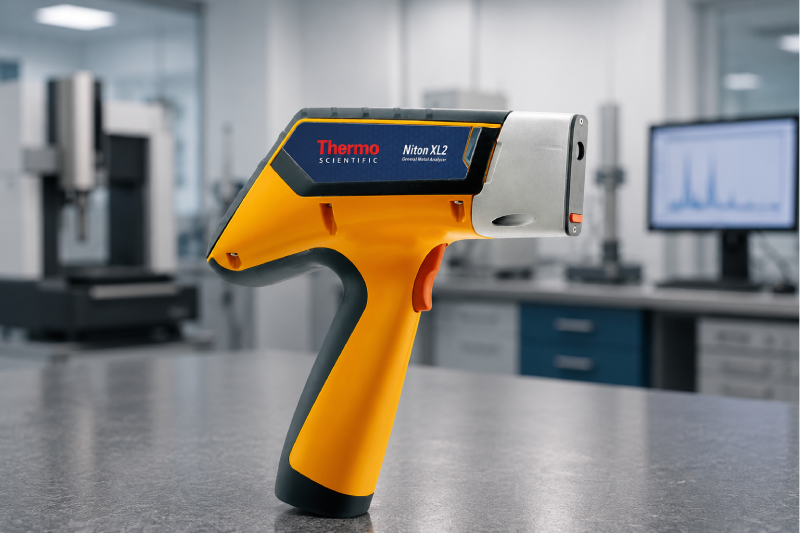
For example, the Thermo Scientific Niton XL2 100G available through QS Metrology supports data transfer through USB and Bluetooth and can generate customized reports and certificates of analysis using its software suite.
Which Pipeline Materials Can Portable XRF Analyzers Help Identify?
Can Portable XRF Analyzers Identify Stainless Steel Alloys?
Yes. XRF is widely used for elemental analysis of metallic alloys and can help differentiate grades based on their elemental composition.
This can support PMI activities involving stainless steel and other alloy families.
Can Handheld XRF Analyzers Identify Nickel Alloys?
Many advanced handheld systems are designed for broad elemental analysis and alloy identification.
The specific measurable elements and detection capability depend on the analyzer model, calibration, material, and application.
Can XRF Analyzers Identify Carbon Steel?
XRF can provide elemental information for many metals and alloys, but users should understand the limitations of XRF for certain light elements and material classifications.
The appropriate analytical technique should always be selected based on the required material specification and measurement objective.
What About Low-Alloy Materials?
Advanced handheld systems can support a wide range of alloy identification applications.
For example, QS Metrology’s Niton XL3t GOLDD+ is specified for a broad analytical range and enhanced detection of elements including Mg, Al, Si, P, and S.
How Do Portable XRF Analyzers Improve Incoming Material Inspection?
One of the most effective applications for portable XRF analyzers is incoming material verification.
What Happens When Raw Materials Arrive at a Fabrication Facility?
Pipes, plates, fittings, flanges, valves, and other components may arrive with certificates and identification markings.
However, quality teams may still need to independently verify material identity.
A portable analyzer allows inspectors to test selected components before they enter production.
How Does This Prevent Material Mix-Ups?
Suppose a fabrication facility receives multiple visually similar stainless-steel grades.
A technician can use a handheld XRF analyzer to verify selected components and compare their elemental composition with the expected grade.
If a mismatch is identified, the material can be isolated before it reaches fabrication.
This is significantly easier than discovering the problem after machining or welding.
How Can PMI Improve Supplier Quality Control?
Material verification can also provide an additional layer of supplier quality assurance.
When inspection results consistently match material documentation, confidence in supplier deliveries increases.
When discrepancies occur, the inspection data can support supplier investigation and corrective action.
How Can Handheld XRF Analyzers Support Weld and Component Traceability?
Material verification does not stop when fabrication begins.
During pipeline fabrication, different components can become mixed after cutting, machining, welding, or movement between production areas.
Why Is Material Traceability Important After Fabrication?
Once a component is cut or modified, its original material identification may become less obvious.
Markings can be removed during machining or become separated from the original material documentation.
This creates a traceability challenge.
How Can Handheld XRF Machines Help?
A handheld analyzer can provide a practical method for rechecking material identity at different stages of fabrication.
For example:
Incoming material → Storage → Cutting → Machining → Welding → Assembly → Final inspection
PMI checks can be incorporated at appropriate stages based on the project’s quality plan.
This creates additional confidence that the correct material remains associated with the correct component throughout fabrication.
How Can Portable XRF Spectrometers Reduce Rework and Production Delays?
Why Is Late Material Identification Expensive?
Consider a component that has already been:
- Received
- Inspected
- Cut
- Machined
- Welded
- Assembled
- Coated
- Documented
If a material mismatch is discovered at the final inspection stage, correcting it can require substantial rework.
The cost is no longer limited to the raw material.
It can include labour, machining, welding, inspection, documentation, schedule disruption, and potentially scrapping the completed component.
How Can Early PMI Change This?
By introducing material verification earlier in the workflow, manufacturers can identify potential mismatches before significant value is added to the component.
This makes portable XRF analyzers useful not only as inspection instruments but also as tools for reducing quality-related production risk.
How Can Portable XRF Analyzers Improve PMI in the Field?
Oil & gas projects frequently involve inspection activities outside controlled laboratory environments.
Pipeline construction, maintenance, shutdowns, plant expansions, and field fabrication can require material verification at locations where laboratory access is limited.
Why Is Portability Important for Pipeline Inspection?
A portable analyzer can be transported directly to the inspection location.
This eliminates the need to move large or difficult-to-handle components simply for material identification.
How Does This Help Shutdown and Maintenance Projects?
During refinery shutdowns or maintenance activities, inspection teams often work against strict schedules.
Rapid PMI can help teams verify components without creating unnecessary laboratory delays.
The ability to perform non-destructive elemental analysis on-site makes portable XRF spectrometers particularly useful for these mobile inspection environments.
What Should Oil & Gas Companies Consider When Selecting XRF Analyzers?
Not every XRF analyzer is designed for the same application.
Before investing in a system, oil & gas companies should evaluate several technical and operational factors.
What Elements Does the XRF Analyzer Detect?
The required elemental range depends on the materials being inspected.
If the application involves alloy identification, the analyzer should support the elements necessary to differentiate the relevant grades.
Does the Handheld XRF Analyzer Support PMI Applications?
Choose a system designed for material identification and alloy analysis rather than selecting solely on portability or price.
How Fast Are the Results?
For incoming inspection and field PMI, rapid results can directly improve inspection productivity.
How Rugged Is the Handheld XRF Machine?
Industrial environments can expose equipment to dust, vibration, temperature changes, and frequent movement.
A rugged instrument can be better suited to demanding field conditions.
QS Metrology highlights rugged construction among the advantages of its Thermo Scientific portable XRF analyzers.
Is the Software Easy to Use?
A straightforward interface can help inspectors perform repeated measurements efficiently.
The Niton XL2 Plus, for example, includes an integrated camera for positioning and a silicon drift detector with ProGuard protection.
Can Inspection Data Be Exported?
Data connectivity and reporting can be important when PMI results need to become part of a larger quality documentation system.
How Can QS Metrology Support Oil & Gas Material Verification?
QS Metrology offers Thermo Scientific portable and handheld XRF analyzers for elemental and material analysis applications in India.
Its portfolio includes:
Niton XL2 100G
The Niton XL2 100G is positioned as a general metal analyzer with point-and-shoot operation and an integrated colour touchscreen for viewing alloy grade and chemistry. It also supports USB and Bluetooth communication and customized reporting through Niton Data Transfer software.
Niton XL2 PLUS
The Niton XL2 PLUS is designed for general metal analysis with lighter-element capabilities and includes features such as a silicon drift detector and integrated camera.
Niton XL3t GOLDD+
The Niton XL3t GOLDD+ is designed for applications including mining, exploration, and scrap metal recycling, while providing a broad analytical range and enhanced light-element detection.
The appropriate model should be selected according to the required elements, material grades, inspection environment, detection requirements, and PMI workflow.
How Can XRF-Based PMI Strengthen Oil & Gas Quality Control?
The biggest advantage of using handheld XRF analyzers for pipeline PMI is not simply speed.
It is the ability to bring elemental analysis closer to the actual manufacturing and inspection process.
Instead of relying entirely on documentation, visual identification, or laboratory turnaround, quality teams can introduce additional verification points throughout the material lifecycle.
A practical PMI workflow can look like:
Supplier Material → Incoming PMI → Material Segregation → Fabrication → In-Process PMI → Assembly → Final Verification → Documentation
This approach can help reduce the probability that an incorrect alloy moves through multiple expensive production stages.
Why Are Handheld XRF Analyzers Becoming Important for Pipeline PMI?
Oil & gas fabrication requires a balance between production speed, quality assurance, traceability, and cost control.
Traditional laboratory analysis remains valuable for applications requiring detailed or certified laboratory measurements. However, many field and production decisions require rapid material identification rather than lengthy laboratory turnaround.
This is where handheld XRF analyzers can add value.
They provide:
- Rapid elemental analysis
- On-site material verification
- Non-destructive testing
- Portable operation
- Alloy identification
- PMI support
- Reduced material mix-up risk
- Faster quality decisions
- Better production workflow
For pipeline manufacturers, fabrication contractors, EPC companies, inspection agencies, and maintenance teams, portable elemental analysis can become an important part of a modern PMI strategy.
Conclusion: How Can Portable XRF Analyzers Improve Oil & Gas PMI?
Material verification is a critical part of quality control in oil & gas pipeline fabrication. A material mix-up discovered after machining, welding, or assembly can result in significant rework, delays, and additional inspection costs.
XRF analyzers provide a practical way to identify elemental composition quickly and non-destructively. Handheld XRF analyzers take this capability directly to the shop floor, warehouse, fabrication area, pipeline project, or field inspection location.
By incorporating a handheld XRF machine into appropriate PMI workflows, oil & gas companies can verify materials earlier, strengthen traceability, reduce the risk of alloy mix-ups, and make faster quality-control decisions.
QS Metrology provides Thermo Scientific portable XRF analyzers designed for rapid elemental analysis of metals, alloys, and other materials, with models available for different industrial applications.
If your oil & gas operation requires faster and more reliable material verification, explore QS Metrology’s portable XRF solutions.
Improve PMI and Material Verification with Portable XRF Analyzers
FAQs About Handheld XRF Analyzers for Oil & Gas PMI
What are handheld XRF analyzers used for in oil & gas?
Handheld XRF analyzers can be used for Positive Material Identification (PMI), alloy identification, incoming material verification, component traceability, and elemental analysis of metallic materials.
How does a portable XRF analyzer identify an alloy?
A portable XRF analyzer exposes the material to X-rays and measures the characteristic fluorescent X-rays emitted by the elements in the material. The resulting elemental composition can then be compared with the expected alloy grade.
Are handheld XRF analyzers suitable for pipeline PMI?
Yes. Their portability, rapid analysis, and non-destructive operation make handheld XRF analyzers suitable for many PMI applications involving pipes, fittings, flanges, valves, and other metallic components. The exact suitability depends on the material, required elements, specification, and inspection procedure.
Can a handheld XRF machine replace laboratory testing?
Not in every application. Handheld XRF is highly useful for rapid field screening, alloy identification, and PMI, but laboratory techniques may still be required when an application demands specific detection limits, trace-element analysis, certified testing, or measurements beyond the capabilities of XRF.
How do portable XRF analyzers reduce material mix-ups?
They allow inspectors to verify elemental composition directly at receiving, storage, fabrication, or installation locations. Detecting an incorrect material earlier can prevent it from progressing through costly manufacturing and fabrication stages.