


Table of Contents
- What Are XRF Analyzers Used for in Scrap Recycling?
- Why Is Accurate Metal Identification Important for Indian Scrap Dealers?
- How Do Handheld XRF Analyzers Work in Scrap Yards?
- How Does a Handheld XRF Machine Improve Scrap Metal Sorting?
- How Do Portable XRF Analyzers Help Reduce Material Misclassification?
- Which Metals Can Handheld XRF Analyzers Help Identify?
- How Can Portable XRF Spectrometers Improve Scrap Purchasing and Selling Decisions?
- How Do XRF Analyzers Support Quality Control in Metal Recycling?
- What Should Scrap Recycling Businesses Consider When Choosing XRF Analyzers?
- How Can QS Metrology Support Scrap Metal Analysis?
- Frequently Asked Questions
India’s scrap recycling industry plays an important role in supplying reusable metals to foundries, steel manufacturers, metal processors, and other industrial businesses. As demand for recycled metals grows, scrap dealers and recycling facilities face a common challenge: identifying the correct metal grade quickly and accurately before purchasing, sorting, processing, or selling scrap.
Visually similar metals can have significantly different elemental compositions and commercial values. A mixed load containing stainless steel, nickel alloys, aluminium alloys, copper-based materials, or other metals can create pricing errors, inconsistent batches, customer disputes, and avoidable processing costs when materials are incorrectly classified.
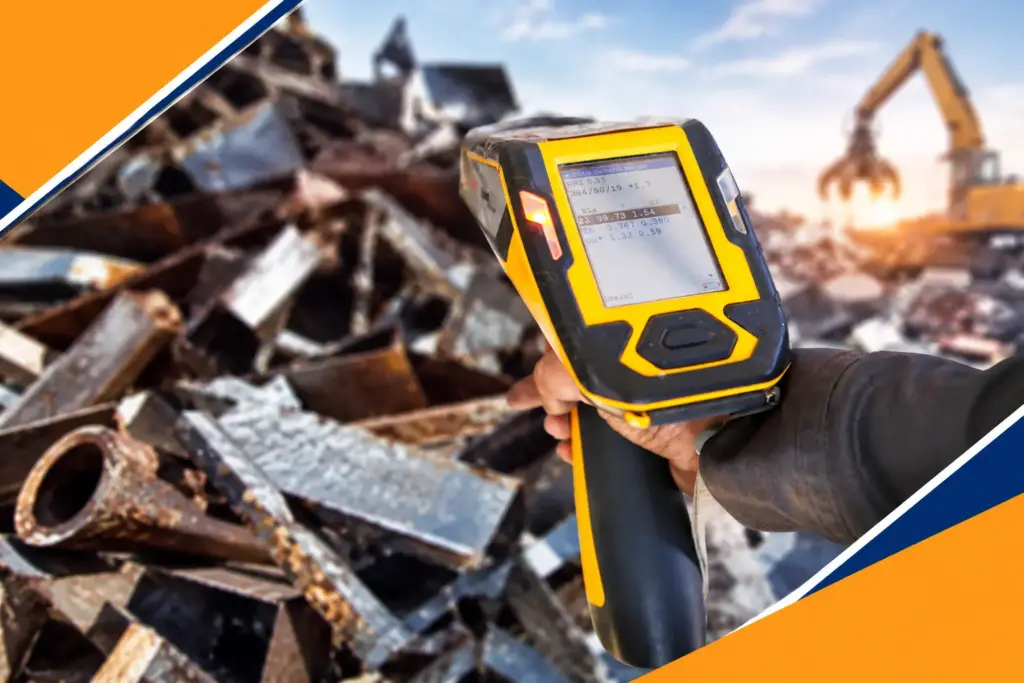
This is where handheld XRF analyzers can make a measurable difference. Using X-ray fluorescence technology, these portable instruments help operators analyze the elemental composition of suitable metal samples directly at scrap yards, collection centres, warehouses, and processing facilities.
By providing rapid, non-destructive material analysis, portable XRF analyzers help recycling businesses make more informed decisions about metal identification, grade segregation, and material quality.
For Indian scrap recyclers looking to improve operational efficiency and strengthen quality control, a suitable portable XRF spectrometer can become an important tool in the material identification workflow.
What Are XRF Analyzers Used for in Scrap Recycling?
XRF analyzers are instruments that use X-ray fluorescence (XRF) to determine the elemental composition of suitable materials. In scrap recycling, they help operators identify and distinguish metal and alloy grades that may look similar but contain different proportions of elements.
For example, two stainless-steel components may appear nearly identical while containing different amounts of chromium, nickel, or molybdenum. These differences can affect how the material is classified, valued, and reused.
A handheld XRF analyzer allows an operator to test a suitable metal surface and obtain elemental information without routinely cutting or destroying the sample.
Common applications in scrap recycling include:
- Identifying and sorting stainless-steel grades.
- Differentiating suitable nickel-bearing alloys.
- Checking the composition of incoming metal scrap.
- Separating mixed metal and alloy batches.
- Verifying material before shipment to a buyer.
- Supporting quality checks on segregated scrap.
- Investigating unidentified metal components.
- Improving material traceability and inspection records.
The exact elements and alloy grades an instrument can identify depend on its configuration, calibration, sample condition, and analytical capabilities.
Why Are Portable XRF Analyzers Useful for Scrap Yards?
Scrap yards handle a wide variety of materials, often in large quantities. Sending every unidentified item to a laboratory before making a sorting decision can be impractical.
Portable XRF analyzers bring elemental analysis to the material. Operators can perform suitable checks where scrap is received, inspected, segregated, stored, or prepared for dispatch.
This helps businesses make faster preliminary decisions while reducing dependence on laboratory testing for routine identification tasks.
Why Is Accurate Metal Identification Important for Indian Scrap Dealers?
Scrap recycling profitability depends on several factors, including purchase prices, recovered material value, processing expenses, contamination, transportation, and the quality requirements of the final buyer.
Incorrect metal identification can affect several of these factors simultaneously.
How Can Incorrect Scrap Classification Affect Profit Margins?
Consider a scrap yard that purchases a mixed load of stainless-steel components. If the operator assumes that all pieces belong to the same grade based on appearance, valuable alloy material could be mixed with a lower-value grade—or material unsuitable for the intended batch could be included.
This can create problems such as:
- Incorrect purchase pricing: The business may pay more or less than justified by the actual material composition.
- Lower-value segregation: Higher-value material may be sold within a lower-grade batch.
- Buyer rejection: A shipment may fail to meet the buyer’s material requirements.
- Additional sorting costs: Workers may need to separate the material again.
- Processing inefficiencies: Mixed compositions can complicate downstream recycling and production.
- Commercial disputes: Differences between declared and measured composition can affect buyer confidence.
A suitable handheld XRF machine helps operators check material identity before these problems move further into the recycling process.
Why Is Metal Segregation Important in Scrap Recycling?
Metal segregation means separating scrap into appropriate material categories or alloy grades before processing or resale.
Effective segregation helps recyclers maintain more consistent batches and communicate material quality more confidently to buyers.
However, visual identification alone may not reliably distinguish every alloy. Labels, markings, magnets, and operator experience can provide useful preliminary information, but they may not establish the elemental composition of an unknown sample.
XRF analysis adds a measurement-based verification step to the sorting process.
How Do Handheld XRF Analyzers Work in Scrap Yards?
Handheld XRF analyzers work on the principle of X-ray fluorescence.
The instrument directs X-rays towards a suitable sample. The atoms in the sample respond by emitting characteristic fluorescent X-rays. A detector measures these signals, and the analyzer’s software interprets them to estimate the elemental composition.
The basic process is:
X-rays directed at the sample → Fluorescent X-rays emitted → Detector measures the signals → Software reports elemental information.
The operator can then use the result to support alloy identification, material segregation, or further inspection.
How Does a Handheld XRF Machine Make On-Site Testing Easier?
A handheld XRF machine is designed to bring analysis directly to the inspection point rather than requiring every component to be transported to a fixed laboratory.
This is particularly useful when scrap yards handle:
- Large metal components that are difficult to move.
- Mixed stainless-steel scrap.
- Industrial offcuts and fabrication remnants.
- Used metal parts with unclear identification.
- Incoming consignments that need preliminary checks.
- Multiple metal grades stored in separate areas.
Portable instruments can support faster screening of suitable samples, allowing workers to investigate material identity before deciding how it should be handled.
Is XRF Testing Destructive?
XRF is generally a non-destructive analytical technique. In typical metal identification applications, it does not require the operator to cut through or consume the sample.
However, the surface must be suitable for reliable measurement. Paint, coatings, dirt, corrosion, surface contamination, geometry, and sample heterogeneity can influence results. Appropriate surface preparation may be needed, and the instrument must be used according to its operating and radiation-safety instructions.
How Does a Handheld XRF Machine Improve Scrap Metal Sorting?
Scrap sorting is not simply about separating metals by appearance. It is about creating material batches that match the intended grade, commercial category, or buyer specification.
Handheld XRF analyzers can help make this process more systematic.
How Can XRF Analyzers Help Separate Mixed Stainless-Steel Grades?
Stainless-steel scrap may contain several grades with different alloy compositions. Although many grades share a similar appearance, their chromium, nickel, molybdenum, and other alloying-element contents can differ.
A handheld XRF analyzer can measure relevant elemental concentrations and help the operator distinguish between supported alloy grades.
For example, when sorting mixed stainless-steel scrap, operators can use measured composition to help determine whether a piece belongs in the intended grade category or requires further verification.
The benefits include:
- Better segregation of identifiable alloy grades.
- Reduced reliance on visual assumptions.
- Fewer opportunities for incompatible materials to enter the same batch.
- More consistent material categories for resale.
- Improved confidence during final inspection.
The analyzer should be configured for the relevant material types, and ambiguous results should be investigated rather than treated as definitive identification.
How Can Portable XRF Analyzers Help Identify Non-Ferrous Metals?
Scrap recyclers also handle non-ferrous metals and alloys, including aluminium-, copper-, and nickel-based materials.
A suitable XRF analyzer can help determine the elemental composition of supported materials and distinguish between certain alloy families.
However, not every metal-identification question can be answered by XRF alone. Aluminium alloy classification, in particular, may require attention to the instrument’s element range and the specific alloying elements that need to be measured. XRF also has limitations for very light elements and does not directly measure carbon content in steel.
For applications requiring precise differentiation based on elements outside the instrument’s capabilities, an alternative analytical method may be necessary.
What Is a Practical XRF-Based Scrap Sorting Workflow?
Scrap recycling businesses can introduce XRF into a structured workflow:
- Receive the material: Record the supplier, consignment, and declared material category.
- Conduct preliminary sorting: Separate obvious material groups using established procedures.
- Select representative pieces: Choose suitable samples from each relevant category or suspect mixed batch.
- Measure the composition: Use the handheld analyzer according to the manufacturer’s instructions.
- Compare the results: Check the reported composition against the intended grade or acceptance criteria.
- Segregate the material: Keep verified categories separate and isolate uncertain or mismatched items.
- Document the inspection: Record results where traceability and business procedures require them.
- Verify before dispatch: Carry out suitable checks before releasing higher-risk or specification-sensitive consignments.
This approach makes elemental analysis part of the sorting process rather than a test performed only after a material problem occurs.
How Do Portable XRF Analyzers Help Reduce Material Misclassification?
Material misclassification happens when a metal is assigned to the wrong category or alloy grade. In recycling, this may occur because of missing labels, mixed consignments, incorrect supplier declarations, or the similarity of different alloys.
A portable XRF analyzer provides elemental evidence that can be compared with the expected material composition.
How Can Scrap Dealers Verify Incoming Materials?
Incoming inspection is an important opportunity to identify discrepancies before material enters inventory or gets mixed with other stock.
When a consignment arrives, a recycler can establish a risk-based inspection plan. Suitable pieces from unidentified, mixed, high-value, or specification-sensitive material categories can be checked using a handheld XRF analyzer.
If the results do not align with the declared grade, the operator can:
- Separate the questionable pieces.
- Conduct additional measurements where appropriate.
- Review supplier documentation.
- Request further material verification.
- Reassess the commercial classification before processing or resale.
The appropriate sampling frequency depends on the consignment, the risk of mixing, the value of the material, and the business’s inspection procedures.
How Can XRF Testing Reduce Rework and Buyer Disputes?
Material errors are usually more expensive to correct after several processing steps have taken place.
For example, discovering a grade mismatch after different scrap categories have been combined can require additional sorting, handling, and testing. If the mismatch is found after dispatch, the business may face a rejected load, a price adjustment, or a dispute.
By introducing suitable XRF checks at receiving, sorting, and dispatch stages, recyclers can identify certain discrepancies earlier.
This does not eliminate every source of error, but it adds a practical verification step that supports more consistent material handling.
Which Metals Can Handheld XRF Analyzers Help Identify?
The range of metals and alloys that can be identified depends on the analyzer model, its calibration, the elements it can measure, and the material being tested.
Typical scrap-recycling applications may include the following.
Material category | Potential XRF application |
Stainless steel | Differentiating supported grades using alloying-element composition |
Nickel-based alloys | Checking relevant elemental composition for alloy identification |
Copper-based alloys | Supporting identification of suitable copper alloys and brass or bronze categories |
Aluminium alloys | Screening supported alloy families when relevant elements are measurable |
Industrial alloy scrap | Verifying composition against the expected material category |
Mixed metal consignments | Investigating unidentified pieces and supporting segregation |
High-value alloy scrap | Checking material identity before commercial classification or dispatch |
Can a Portable XRF Spectrometer Identify Every Element in Scrap Metal?
No. A portable XRF spectrometer is not a universal solution for every elemental analysis requirement.
XRF is effective for many alloy-identification tasks, but performance varies by element, instrument configuration, sample characteristics, and testing conditions.
For example, carbon content cannot be directly measured by conventional handheld XRF analyzers, so XRF alone cannot reliably distinguish steel grades when carbon content is the decisive difference. Some other light elements may also be difficult to measure reliably with particular instruments or setups.
Where the required grade depends on carbon or other elements outside the analyzer’s reliable measurement range, techniques such as optical emission spectroscopy (OES) or laboratory analysis may be required.
The correct approach is to match the instrument to the actual material grades and purchasing or selling specifications involved.
How Can Portable XRF Spectrometers Improve Scrap Purchasing and Selling Decisions?
Scrap buyers and sellers need dependable material information to make commercial decisions. When the composition of a material is uncertain, pricing and grade allocation can become more difficult.
Portable XRF spectrometers can help by providing rapid elemental information at the point where the material is inspected.
How Can XRF Analysis Support Scrap Purchasing?
Before purchasing a consignment, a scrap dealer may need to establish whether the material matches the seller’s description.
Testing suitable samples can help the buyer assess whether the declared alloy category is consistent with the measured composition.
This supports more informed decisions about:
- Whether to accept the material as declared.
- Whether additional inspection is needed.
- Whether different material categories should be priced separately.
- Whether a mixed consignment requires further sorting.
- Whether the material should be held for confirmation before purchase.
XRF results should be interpreted within a defined inspection process. A single measurement may not represent an entire mixed load, particularly when the material contains several different components.
How Can Portable XRF Analyzers Help Before Dispatch?
Before selling or dispatching a segregated batch, recyclers may use XRF to check selected pieces against the intended material category.
This can help identify obvious mismatches and support more consistent outgoing inspection.
Where customers specify a particular alloy grade or chemical composition, the inspection plan should define the acceptance criteria, sampling approach, documentation requirements, and any need for confirmatory testing.
The commercial value comes from better-informed decisions—not from assuming that one handheld measurement automatically certifies an entire shipment.
How Do XRF Analyzers Support Quality Control in Metal Recycling?
Quality control in recycling involves more than identifying individual pieces. It also includes maintaining consistent processes, preventing material mixing, and creating dependable inspection records.
A handheld XRF analyzer can support these activities when it is incorporated into the recycler’s quality procedures.
How Can XRF Results Improve Material Traceability?
Where the instrument and software support suitable data management, operators may record inspection results alongside details such as:
- Supplier or consignment reference.
- Material category or expected alloy grade.
- Inspection date and location.
- Measured elemental composition.
- Operator or inspector identification.
- Acceptance, segregation, or further-testing decision.
These records can help supervisors investigate material discrepancies, review supplier performance, and improve consistency between shifts.
Data collection and reporting capabilities differ by model and software configuration, so recyclers should verify that a proposed system meets their documentation requirements.
How Can Standardized Testing Improve Sorting Consistency?
Without a defined inspection procedure, different operators may use different assumptions when classifying similar materials.
A standardized workflow can specify which material categories require testing, how samples should be prepared, which measurement mode should be used, and what actions to take when results are uncertain.
Combining this procedure with appropriate operator training helps make material decisions more consistent across receiving, sorting, storage, and dispatch operations.
XRF should complement—not replace—proper radiation-safety practices, supplier controls, material handling procedures, and other required quality checks.
What Should Scrap Recycling Businesses Consider When Choosing XRF Analyzers?
Not all XRF analyzers have the same capabilities. Selecting a suitable instrument requires understanding the materials being processed and the decisions the business needs to make.
Which Features Matter Most in Handheld XRF Analyzers?
- Elemental range
Identify the elements needed to distinguish the alloys in your scrap inventory. Confirm that the instrument can measure those elements with suitable performance.
- Alloy-grade identification
Check whether the instrument’s supported grade libraries and analytical modes match the stainless steel, nickel alloys, copper alloys, and other materials commonly handled by the business.
- Measurement speed
Fast measurements can help maintain throughput in busy yards. However, the required measurement time depends on the sample, element, and desired analytical confidence.
- Portability and durability
Consider the weight, ergonomics, battery operation, and suitability of the instrument for the working environment.
- Data management
If the business needs inspection records, verify available export, connectivity, and reporting features.
- Operator training and technical support
Training helps operators understand measurement limitations, sample preparation, instrument handling, and the correct interpretation of results.
- Safety features
Because handheld XRF instruments use X-rays, assess the manufacturer’s safety systems, operating procedures, training requirements, and applicable local regulations.
- Total cost of ownership
Consider not only the purchase price but also training, maintenance, support, accessories, and the expected applications over the instrument’s service life.
Which Portable XRF Analyzer Should a Scrap Recycler Consider?
QS Metrology lists Thermo Scientific Niton instruments in its portable XRF portfolio, including:
- Niton XL2 100G: Positioned as a general metal analyzer for point-and-shoot alloy identification.
- Niton XL2 PLUS: A general metal analysis option with additional capabilities for lighter elements, depending on configuration.
- Niton XL3t GOLDD+: A handheld analyzer designed for a broad range of elemental analysis applications, including scrap metal recycling.
The appropriate model depends on the alloys being processed, the elements that must be measured, required measurement performance, and operating conditions.
Before selecting a system, recyclers should discuss representative samples and actual grade-identification requirements with the supplier. This is especially important when the commercial classification depends on elements that handheld XRF cannot measure directly.
How Can QS Metrology Support Scrap Metal Analysis?
QS Metrology supplies portable and handheld XRF analyzers for industrial elemental analysis and material verification applications.
Its portfolio includes Thermo Scientific Niton instruments designed to support on-site testing, alloy identification, and other suitable material-analysis workflows.
For scrap recycling businesses, choosing an instrument should begin with the actual materials handled at the facility. A stainless-steel recycler, a mixed non-ferrous scrap dealer, and a business processing specialist nickel alloys may have different analytical requirements.
QS Metrology can help businesses evaluate suitable instrument options based on:
- The metal and alloy categories handled.
- The elements that need to be measured.
- The type and condition of scrap samples.
- Expected inspection volume and working environment.
- Data management and reporting needs.
- Operator training and after-sales support requirements.
A suitable portable XRF analyzer can help scrap recycling businesses introduce faster material checks, improve sorting decisions, and identify certain material mismatches earlier in the process.
To explore available systems, visit the QS Metrology portable XRF analyzers product page.
Conclusion: How Can Handheld XRF Analyzers Help Scrap Recyclers Work Smarter?
For India’s scrap recycling industry, accurate metal identification is essential for maintaining material quality, controlling processing costs, and making informed buying and selling decisions.
Handheld XRF analyzers provide rapid, non-destructive elemental analysis for many suitable metal and alloy identification applications. By introducing XRF checks at receiving, sorting, and dispatch stages, recycling businesses can improve material segregation, investigate questionable consignments, and strengthen their inspection procedures.
However, successful implementation depends on choosing an analyzer that matches the materials being processed, understanding its analytical limitations, and using a consistent sampling and verification process.
Looking to improve metal sorting and material verification at your scrap recycling facility? Explore QS Metrology’s portable XRF analyzer range and discuss your alloy-identification requirements with its team.
Discuss Your Scrap Metal Analysis Requirements
Frequently Asked Questions
What are XRF analyzers used for in scrap recycling?
XRF analyzers are used to identify the elemental composition of suitable metal and alloy samples. In scrap recycling, they can support alloy identification, metal sorting, incoming material verification, mixed-batch investigation, and outgoing quality checks.
How do handheld XRF analyzers help scrap dealers improve sorting accuracy?
Handheld XRF analyzers measure characteristic fluorescent X-rays from a sample to estimate its elemental composition. Operators can compare these results with the expected alloy grade and use them to separate suitable material categories or flag pieces that need further testing.
Can a handheld XRF machine identify stainless-steel and non-ferrous alloys?
Yes, a suitably configured handheld XRF machine can help identify many stainless-steel, nickel-based, copper-based, and other supported alloy grades. The exact capability depends on the instrument, measurable elements, calibration, and sample conditions.
Can portable XRF analyzers measure carbon in steel?
Conventional handheld XRF analyzers cannot directly measure carbon content. If steel-grade identification depends on carbon concentration, another analytical method—such as optical emission spectroscopy—may be required. Users should select the technique based on the relevant material specification.
How can scrap recycling businesses choose the right portable XRF spectrometer?
Businesses should evaluate the alloys they handle, the elements they need to measure, grade-identification requirements, measurement speed, portability, data management, safety features, and technical support. Discussing representative samples and real inspection needs with a supplier can help identify a suitable model.