


QS Metrology | Portable XRF Analyser | Portable XRF Spectrometer | Optical Emission spectrometer | XRD | Surface roughness Tester | roughness measuring machine | Portable Roughness Tester | Contour measuring machine | Contour Tester | Coordinate measuring machine | 3 D Coordinate measuring machine | Weld penetration inspection | Weld penetration measurement System | Stereomicroscope | Coating thickness tester | Video Measuring machine | Metallurgical Image analysis | Metallurgical microscope

Prevent Costly Material Mix-Ups: The Role of Handheld XRF Analyzers in Alloy Sorting & Verification

Prevent Costly Material Mix-Ups The Role of Handheld XRF Analyzers in Alloy Sorting & Verification

One Small Mix-Up, Massive Losses

Imagine this—your production line is running smoothly, deadlines are tight, and a batch is ready to ship. But later, you discover the wrong alloy grade was used. The result? Rejections, rework, and a serious dent in your reputation.
Material mix-ups in metal and alloy manufacturing aren’t rare—they’re expensive, stressful, and often avoidable.

This is exactly where handheld XRF analyzers step in.

In this blog, we’ll break down how these powerful tools help you eliminate costly errors, improve quality control, and bring confidence back to your inspection process.

Table of Contents

  • What Causes Material Mix-Ups in Metal Manufacturing?
  • What Are Handheld XRF Analyzers?
  • How XRF Technology Works (Simplified)
  • Why Alloy Verification Matters More Than Ever
  • Key Benefits of Handheld XRF in Alloy Sorting
  • Real-World Applications Across Industries
  • How to Choose the Right XRF Analyzer
  • FAQs
  • Conclusion

What Causes Material Mix-Ups in Metal Manufacturing?

Let’s be honest—most mix-ups don’t happen because of negligence. They happen because of process gaps.
In busy manufacturing environments, materials often look identical. Stainless steel grades, nickel alloys, and mixed scrap can easily be confused without proper verification. Relying on manual labeling, supplier trust, or visual inspection just isn’t enough anymore.

Here are common causes:

  • Similar-looking alloys stored together
  • Incorrect labeling or human error
  • Supplier inconsistencies
  • Lack of on-site testing tools
  • Time pressure leading to skipped inspections

And the consequences?

  • Scrap and rework costs
  • Customer complaints or rejections
  • Compliance issues
  • Production delays

This is why real-time verification is no longer optional—it’s essential.

What Are Handheld XRF Analyzers?

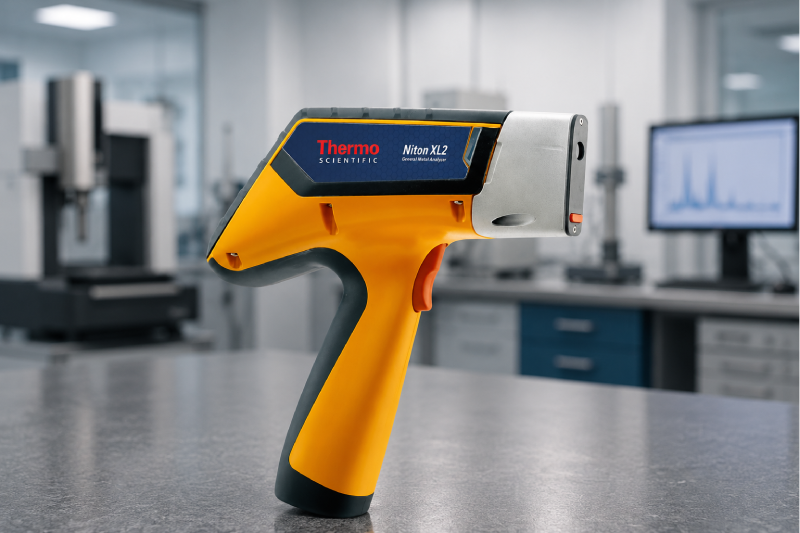
Handheld XRF analyzers are portable devices that use x ray fluorescence spectroscopy to instantly determine the elemental composition of metals.

In simple terms, they tell you exactly what material you’re working with—within seconds.
Unlike traditional lab testing, these devices bring the lab directly to your shop floor. No waiting. No guesswork.

They are widely used for:

  • Alloy grade identification
  • Positive Material Identification (PMI)
  • Scrap metal sorting
  • Incoming material inspection

How Does X Ray Fluorescence Analysis (XRF) Work?

Let’s keep it simple.

X ray fluorescence analysis (XRF) works by directing X-rays onto a material. The material emits secondary (fluorescent) X-rays, which are unique to each element.

The analyzer reads this signal and gives you a detailed composition breakdown.

Key Highlights:

  • Non-destructive testing
  • Results in seconds
  • No sample preparation required
  • Highly accurate and repeatable

This is why xrf analyzers have become a go-to solution across metal industries.

Why Alloy Verification Matters More Than Ever?

If you’re in manufacturing, you already know—one wrong material can ruin an entire batch.
But today, the stakes are even higher.
With stricter compliance standards in industries like automotive and aerospace, there’s zero room for error. Customers demand traceability, and audits are more rigorous than ever.

Without proper alloy verification:

  • You risk product failures
  • You lose customer trust
  • You face regulatory penalties

Handheld XRF gives you confidence at every stage—from raw material intake to final inspection.

Key Benefits of Handheld XRF Analyzers in Alloy Sorting

1. Instant Material Identification

No more waiting for lab reports. With handheld XRF analyzers, you get results in seconds, right on the shop floor.

2. Eliminate Human Error

Manual identification is risky. XRF removes guesswork and ensures accurate alloy verification every time.

3. Reduce Scrap and Rework

By catching errors early, you avoid costly downstream issues.

4. Improve Supplier Quality Control

Verify incoming materials before they enter production. Don’t rely on supplier claims—verify them.

5. Boost Productivity

Faster inspections mean smoother workflows and less downtime.

6. Ensure Compliance

Meet industry standards and maintain proper documentation for audits.

Real-World Applications Across Industries

  • Metal & Alloy Manufacturing: Ensure correct alloy usage during production and avoid cross-contamination.
  • Foundries & Casting Companies: Verify melt composition and prevent incorrect pours.
  • Fabrication & Machining: Confirm material before machining to avoid tool damage and waste.
  • Automotive & Aerospace: Maintain strict compliance with material standards and traceability.
  • Scrap Metal Recycling: Quickly sort and classify metals for better pricing and efficiency.

How to Choose the Right Handheld XRF Analyzer?

Not all xrf analyzers are built the same. Choosing the right one depends on your application.

Here’s what to look for:

  • Accuracy & Detection Range: Ensure it can detect the elements relevant to your alloys.
  • Speed & Ease of Use: Your team should be able to use it without complex training.
  • Durability: Shop floor conditions demand rugged devices.
  • Data Management: Look for features like report generation and traceability.
  • Support & Service: Reliable after-sales support is crucial for long-term use.

Pro Tips to Maximize ROI from XRF Analyzers

  • Train your team properly for consistent results
  • Use XRF at multiple stages (incoming, in-process, final)
  • Maintain calibration regularly
  • Integrate with your quality management system

These small steps can significantly increase your return on investment.

Conclusion: Stop Guessing, Start Verifying

Material mix-ups are silent profit killers. They don’t just affect one batch—they impact your entire operation, from costs to credibility.
The good news?
You don’t have to rely on assumptions anymore.
Handheld XRF analyzers give you the power to verify, validate, and move forward with confidence. Whether you’re sorting scrap, checking incoming materials, or ensuring final product quality—this technology puts you in control.

FAQs

What are handheld XRF analyzers used for?
They are used for identifying metal composition, alloy verification, PMI, and scrap sorting.
It provides highly accurate and repeatable results for most metals and alloys within seconds.
For many applications, yes. However, lab testing may still be needed for highly specialized analysis.
Yes, modern devices are designed with safety features and comply with radiation standards.
Metal manufacturing, aerospace, automotive, oil & gas, and recycling industries widely use them.
Scroll to Top