


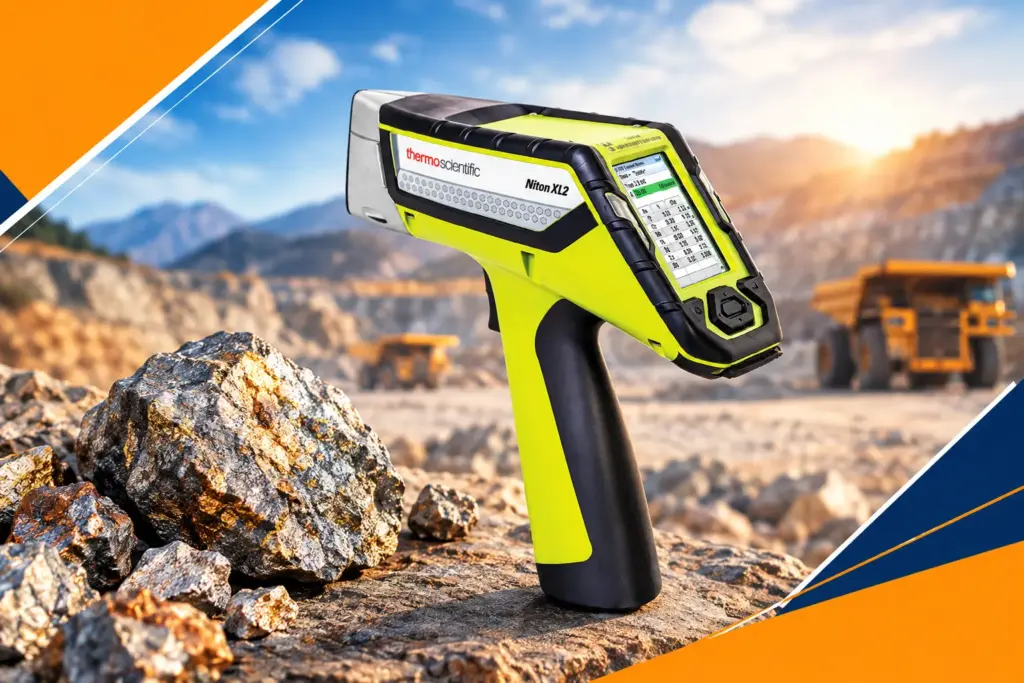
Mining is an industry where decisions often need to be made far away from a laboratory.
Geologists, exploration teams, mine operators, mineral processors, and quality-control professionals routinely need to understand the elemental composition of rocks, ores, concentrates, stockpiles, and other geological materials. Traditional laboratory analysis remains important for detailed and definitive testing, but waiting for laboratory results can slow down exploration, grade control, material segregation, and production decisions.
This is where portable XRF analyzers provide a practical advantage.
Portable X-ray fluorescence technology allows mining teams to perform rapid, non-destructive elemental analysis directly at the exploration site, mine, stockpile, processing area, or laboratory preparation location. Instead of transporting every sample to a central laboratory before making an initial decision, teams can obtain fast elemental information closer to where the material is located.
Modern handheld XRF analyzers combine portability, rapid measurement, intuitive operation, and elemental analysis capabilities in a compact instrument. This makes them valuable for applications ranging from geological exploration and ore characterization to grade control, material sorting, and process monitoring.
For mining organizations looking to improve field productivity while maintaining analytical control, a portable XRF spectrometer can become an important part of the material-analysis workflow.
Table of Contents
- What Are XRF Analyzers Used for in Mining?
- Why Is Fast Mineral Analysis Important for Mining Operations?
- How Do Portable XRF Analyzers Work?
- How Do Handheld XRF Analyzers Help With Geological Exploration?
- How Can a Handheld XRF Machine Support Grade Control?
- How Do Portable XRF Analyzers Improve Ore and Material Sorting?
- Which Elements Can XRF Analyzers Help Identify?
- How Can Portable XRF Spectrometers Reduce Sampling Delays?
- How Do Handheld XRF Analyzers Support Mineral Processing?
- How Can Portable XRF Analyzers Improve Stockpile Management?
- What Are the Advantages of Handheld XRF Machines Over Conventional Field Testing?
- How Should Mining Companies Choose XRF Analyzers?
- How Can QS Metrology Support Mining & Mineral Analysis?
- Conclusion
- FAQs
What Are XRF Analyzers Used for in Mining?
XRF analyzers use X-ray fluorescence to determine the elemental composition of a material.
In mining, this capability can help teams understand the elemental characteristics of geological samples and mineral-bearing materials without transporting every sample to a laboratory for an initial screening decision.
Potential applications include:
- Geological exploration
- Ore characterization
- Grade control
- Mineral identification
- Stockpile analysis
- Material sorting
- Process monitoring
- Concentrate analysis
- Environmental screening
- Quality control
- Field investigation
The exact analytical capability depends on the instrument configuration, sample matrix, calibration, elements of interest, and testing conditions.
Why Are XRF Analyzers Useful in Mining?
Mining operations generate enormous amounts of geological and material data.
The challenge is not simply collecting samples. The challenge is obtaining useful analytical information quickly enough to support operational decisions.
This is where portable technology becomes valuable.
A field team can take a handheld XRF analyzer to the material instead of always taking the material to a laboratory.
That difference can significantly improve the speed of preliminary decision-making.
Why Is Fast Mineral Analysis Important for Mining Operations?
Mining decisions often depend on understanding how material composition changes from one location, layer, sample, stockpile, or processing stage to another.
A laboratory remains essential for detailed analytical work, but not every field decision requires the same level of laboratory analysis.
How Can Delayed Analysis Affect Mining Operations?
When samples must be collected, transported, prepared, analyzed, and reported before an initial decision can be made, the workflow can become slower.
This may affect:
- Exploration planning
- Drill-site decisions
- Sampling strategies
- Grade-control activities
- Material segregation
- Stockpile management
- Processing decisions
- Resource evaluation
Portable XRF analysis can provide rapid elemental information that helps teams decide which samples or areas warrant further laboratory investigation.
Can Portable XRF Replace Laboratory Analysis?
Not universally.
This distinction is important.
Portable XRF analyzers are best viewed as a complementary analytical tool, particularly for rapid screening, field analysis, material characterization, and decision support.
Where an application requires highly specific detection limits, certified laboratory results, trace-element analysis, or analytical capabilities beyond the instrument’s configuration, laboratory methods may still be required.
The best workflow is often:
Field XRF Screening → Identify Important Samples → Laboratory Confirmation → Detailed Analysis
This can help mining teams use laboratory resources more strategically.
How Do Portable XRF Analyzers Work?
A portable XRF spectrometer works using the principle of X-ray fluorescence.
The analyzer directs X-rays toward the sample surface. The atoms within the material respond by emitting characteristic secondary X-rays. The detector measures these signals and the instrument’s software interprets them to provide information about the elements present.
In simple terms:
X-rays → Sample → Fluorescent X-rays → Detector → Elemental Information
Because the analysis can be performed without destroying the sample, XRF is useful for many mining applications where preserving the material is important.
How Does a Handheld XRF Machine Make Field Testing Easier?
A handheld XRF machine puts the analytical instrument directly in the hands of the inspection or geological team.
Instead of moving geological material through multiple locations before obtaining preliminary analytical information, the operator can take the analyzer to the sample.
This is especially useful in:
- Remote exploration areas
- Mine sites
- Drill-core facilities
- Stockpiles
- Mineral processing areas
- Material receiving points
QS Metrology describes its portable XRF systems as lightweight, battery-operated and suitable for on-site analysis.
How Do Handheld XRF Analyzers Help With Geological Exploration?
Exploration is one of the areas where speed can have a major operational impact.
Exploration teams may need to evaluate large numbers of geological samples before determining which locations require more detailed investigation.
How Can Portable XRF Analyzers Support Exploration Screening?
A portable XRF analyzer can provide elemental information directly in the field or at an exploration facility.
This can help teams:
- Compare samples from different locations
- Identify elemental trends
- Screen geological materials
- Prioritize samples for laboratory analysis
- Support geological mapping
- Investigate mineralization patterns
- Reduce delays between sampling and preliminary interpretation
The value is not simply the speed of a single measurement.
The larger benefit comes from being able to analyze more relevant samples closer to the point of collection and use that information to guide subsequent work.
Why Is Rapid Elemental Mapping Valuable?
Geological environments can change significantly across relatively short distances.
When elemental data can be collected quickly across multiple samples, geologists may be able to identify trends that warrant closer investigation.
Portable XRF therefore becomes a field decision-support tool, rather than simply a replacement for laboratory analysis.
How Can a Handheld XRF Machine Support Grade Control?
Grade control is critical because mining operations need to distinguish material that meets production or processing requirements from material that does not.
The precise definition of grade depends on the commodity and mining operation.
How Does XRF Support Grade-Control Decisions?
A handheld XRF machine can provide rapid elemental measurements that help operators and geologists characterize material.
For example, measurements can be used to compare:
- Ore zones
- Waste zones
- Stockpiles
- Blended materials
- Geological samples
- Process feed materials
The resulting information can support decisions about where material should be directed or whether additional laboratory testing is required.
Can Handheld XRF Analyzers Improve Material Segregation?
Yes, where the target elements and material characteristics are suitable for XRF analysis.
Rapid measurements can help teams distinguish materials based on elemental composition and reduce reliance on visual classification alone.
This can be particularly useful when materials appear visually similar but have different chemical characteristics.
How Do Portable XRF Analyzers Improve Ore and Material Sorting?
Material sorting is an important part of mining and mineral processing.
Different materials can have significantly different economic value, but visual appearance alone may not always provide sufficient information for classification.
How Can XRF Analyzers Support Ore Sorting?
Portable XRF analyzers can provide elemental information that helps teams characterize material before it moves to the next stage.
A typical workflow could be:
Sample Collection → XRF Measurement → Elemental Assessment → Material Classification → Further Testing or Processing
This can help reduce uncertainty during preliminary sorting.
What Is the Business Benefit of Faster Sorting?
Faster identification can help reduce unnecessary movement or processing of material that does not meet the desired characteristics.
Potential benefits include:
- Better material segregation
- Faster operational decisions
- Reduced unnecessary testing
- Improved sampling efficiency
- Better utilization of processing capacity
- More informed stockpile management
The exact benefit depends on the mineral, grade-control methodology, instrument configuration, and site workflow.
Which Elements Can XRF Analyzers Help Identify?
XRF is an elemental analysis technique, but the elements that can be measured effectively depend on the analyzer, detector, calibration, sample matrix and measurement conditions.
Modern systems can be configured for a range of applications.
What Materials Can Portable XRF Spectrometers Analyze?
Portable XRF technology can be used across a variety of geological and industrial materials, subject to the instrument’s specifications and calibration.
Potential applications include:
- Ores
- Rocks
- Minerals
- Concentrates
- Metal-bearing materials
- Geological samples
- Soil and environmental samples
- Industrial materials
QS Metrology positions its portable XRF range for applications involving metals, alloys, mining, metallurgy and environmental analysis.
Why Does Element Selection Matter When Choosing an XRF Analyzer?
Mining companies should not select an analyzer based only on portability.
The more important question is:
Can the selected instrument reliably address the elements and matrices relevant to the mining application?
Before purchasing, teams should define:
- Target elements
- Expected concentration ranges
- Sample types
- Required detection limits
- Field conditions
- Measurement frequency
- Required reporting
- Laboratory correlation requirements
This helps ensure that the selected system matches the actual analytical workflow.
How Can Portable XRF Spectrometers Reduce Sampling Delays?
Traditional sampling workflows can involve multiple stages:
- Sample collection
- Labelling
- Transportation
- Sample preparation
- Laboratory analysis
- Data processing
- Reporting
- Decision-making
For detailed analysis, this workflow can be appropriate.
However, not every sample needs to follow the full laboratory process immediately.
How Do Portable XRF Analyzers Accelerate Preliminary Analysis?
A portable XRF spectrometer can introduce an additional analytical step closer to the sample location.
This allows teams to perform rapid screening before deciding which samples need more comprehensive laboratory investigation.
The result can be a more efficient analytical hierarchy:
Large Sample Population
↓
Rapid XRF Screening
↓
Identify High-Priority Samples
↓
Laboratory Confirmation
↓
Detailed Analysis
This can help reduce unnecessary laboratory workload while preserving laboratory testing for applications where it is most valuable.
How Do Handheld XRF Analyzers Support Mineral Processing?
Mining does not end when ore is extracted.
Once material reaches the processing stage, operators need to understand changes in material composition and monitor the characteristics of feedstock and products.
How Can XRF Support Process Monitoring?
Depending on the application, portable XRF measurements can provide rapid elemental information at different points in the material-processing workflow.
Potential use cases include:
- Feed material screening
- Concentrate checks
- Material comparison
- Process-development studies
- Stockpile verification
- Investigation of unexpected material changes
This information can complement laboratory testing and other process-control techniques.
Why Is Rapid Feedback Important in Mineral Processing?
If a change in material composition is identified only after a long laboratory turnaround, the process may have already moved forward.
Rapid screening can help teams investigate unusual results sooner and determine whether more detailed testing is required.
How Can Portable XRF Analyzers Improve Stockpile Management?
Stockpiles can contain large quantities of material collected from different production areas, geological zones, or processing stages.
The challenge is understanding whether the material remains within the expected compositional range.
How Can XRF Help Characterize Stockpiles?
A portable XRF analyzer allows operators to perform measurements at selected locations or samples from a stockpile.
The data can help teams compare material characteristics and identify potential differences that warrant further investigation.
This can support:
- Stockpile classification
- Blending decisions
- Material segregation
- Sampling strategy
- Inventory characterization
The analyzer does not replace a statistically designed sampling plan. Instead, it can provide rapid analytical information within that broader quality-control framework.
What Are the Advantages of Handheld XRF Machines Over Conventional Field Testing?
For many mining applications, the key advantage is bringing elemental analysis closer to the material.
How Do Handheld XRF Analyzers Improve Field Productivity?
A handheld system can offer:
Portability
Operators can carry the analyzer to remote or difficult-to-access locations.
Rapid Results
Fast analysis can support quicker preliminary decisions.
Non-Destructive Analysis
The material can generally remain intact after measurement.
Minimal Sample Handling
Many applications can be measured without extensive preparation, depending on the sample.
Operational Flexibility
The same instrument can potentially support multiple field and production applications.
Reduced Laboratory Dependency for Screening
Suitable samples can be screened before being sent for detailed laboratory analysis.
QS Metrology lists fast elemental analysis, portability, non-destructive testing, user-friendly operation and versatile applications among the key characteristics of its portable and handheld XRF range.
How Should Mining Companies Choose XRF Analyzers?
Choosing the right XRF analyzer requires looking beyond basic specifications.
The instrument should be selected around the mining operation’s actual analytical requirements.
Which Features Should You Evaluate in a Portable XRF Spectrometer?
Consider the following factors:
Selection Factor | Why It Matters |
Target elements | Determines whether the analyzer fits the application |
Sample matrix | Different materials can require different calibrations |
Detection capability | Important for low-concentration applications |
Measurement speed | Affects field productivity |
Portability | Important for remote or mobile inspections |
Ruggedness | Relevant to demanding mining environments |
User interface | Helps operators perform repeat measurements efficiently |
Data management | Useful for recording and transferring results |
Reporting | Supports documentation and analysis |
Training and support | Helps ensure proper instrument use |
Which Portable XRF Analyzer Models Does QS Metrology Offer?
QS Metrology’s current portfolio includes:
- Niton XL2 100G – positioned as a general metal analyzer with point-and-shoot operation.
- Niton XL2 PLUS – general metal analysis with lighter-element capabilities and an integrated camera.
- Niton XL3t GOLDD+ – positioned for applications including mining and exploration.
The correct model should be selected according to the elements, sample types, required analytical performance, operating environment and workflow.
How Can QS Metrology Support Mining & Mineral Analysis?
QS Metrology offers portable and handheld XRF analyzers designed for rapid, non-destructive elemental analysis.
The company provides Thermo Scientific portable XRF solutions and supports applications across mining, metallurgy, manufacturing, environmental analysis and other industrial sectors.
How Can Technical Support Improve XRF Implementation?
Purchasing an analyzer is only one part of implementing an effective analytical workflow.
Mining organizations also need to consider:
- Application suitability
- Instrument selection
- Operator training
- Calibration requirements
- Measurement procedures
- Data interpretation
- Maintenance
- After-sales support
QS Metrology highlights technical support and training as part of its offering.
Why Is Application-Specific XRF Selection Important?
A mining company should not simply purchase the most powerful or expensive analyzer available.
The right system is the one that matches the actual analytical problem.
For example, an exploration team may have different requirements from a mineral-processing plant or a mining laboratory.
A consultation with an experienced XRF supplier can therefore help identify the appropriate configuration before investment.
How Can Mining Companies Build a More Efficient XRF Workflow?
A successful XRF program should be integrated into the existing sampling and quality-control process.
A practical workflow can include:
Step 1: Define the Analytical Objective
Determine whether the goal is exploration screening, grade control, material sorting, stockpile characterization or process monitoring.
Step 2: Identify Target Elements
Determine which elements need to be detected or compared.
Step 3: Establish Sampling Procedures
Define where, when and how samples will be collected.
Step 4: Perform Rapid XRF Analysis
Use the handheld XRF machine to obtain preliminary elemental information.
Step 5: Identify Samples Requiring Further Testing
Select samples that require detailed laboratory analysis or confirmation.
Step 6: Correlate XRF With Laboratory Results
Where appropriate, compare field XRF results with laboratory data to establish confidence in the workflow.
Step 7: Maintain Digital Records
Record measurement data and relevant sample information for future comparison.
Step 8: Use Results for Operational Decisions
Apply the data to exploration, classification, sorting, processing or quality-control decisions within the established technical framework.
This approach allows XRF to become part of a broader data-driven mining strategy.
Why Are Portable XRF Analyzers Becoming Important for Modern Mining?
Mining operations increasingly depend on faster information.
The competitive advantage does not necessarily come from measuring everything in the laboratory. It can come from knowing which information is needed immediately and which information requires deeper analysis.
Portable XRF technology helps bridge this gap.
A portable XRF spectrometer can provide rapid elemental information where the material is located, allowing mining teams to make informed preliminary decisions and prioritize detailed laboratory analysis.
For exploration teams, this can mean faster field assessment.
For grade-control teams, it can mean quicker material characterization.
For processing teams, it can mean faster investigation of material changes.
For stockpile managers, it can mean better compositional understanding.
The technology therefore supports a broader objective: turning material data into faster operational decisions.
Conclusion: How Can XRF Analyzers Improve Mining Operations?
Mining requires continuous decisions about material composition, grade, classification, processing and quality.
Traditional laboratory analysis remains essential for many applications, but relying exclusively on laboratory turnaround can slow down field and operational decision-making.
XRF analyzers, particularly portable and handheld systems, provide an efficient way to bring elemental analysis closer to the point of sampling.
From exploration and grade control to material sorting, stockpile characterization and process monitoring, handheld XRF analyzers can provide rapid analytical information without destroying the material.
A handheld XRF machine can therefore become an important tool for mining teams that need faster field intelligence, while a portable XRF spectrometer can complement laboratory analysis as part of a broader analytical workflow.
The key is choosing the right instrument for the target elements, material matrix, detection requirements and operating environment.
Ready to Bring Faster Elemental Analysis to Your Mining Operation?
Explore QS Metrology’s range of portable XRF analyzers and discuss your mining, exploration or mineral-analysis requirements with an XRF specialist.
Frequently Asked Questions
What are XRF analyzers used for in mining?
XRF analyzers are used for rapid elemental analysis of geological and mineral materials. Depending on the application, they can support exploration, ore characterization, grade-control activities, material sorting, stockpile assessment and process monitoring.
How do handheld XRF analyzers work?
Handheld XRF analyzers expose a material to X-rays and detect the characteristic fluorescent X-rays emitted by its elements. The instrument processes these signals to provide information about the material’s elemental composition.
Can a handheld XRF machine be used for mineral exploration?
Yes. Portable XRF technology can support field exploration by providing rapid elemental information from suitable geological samples. It can help teams screen samples, investigate elemental trends and prioritize material for detailed laboratory analysis.
Can portable XRF analyzers replace laboratory testing?
Not in every application. Portable XRF analyzers are highly useful for rapid field screening and elemental analysis, but laboratory testing may still be necessary when specific detection limits, certification, trace-element analysis or other specialized analytical requirements apply.
How do portable XRF spectrometers benefit mining companies?
Portable XRF spectrometers can provide rapid, non-destructive elemental information directly at the inspection or sampling location. This can help reduce delays in preliminary analysis, support faster material decisions, prioritize laboratory testing and improve the efficiency of exploration and quality-control workflows.